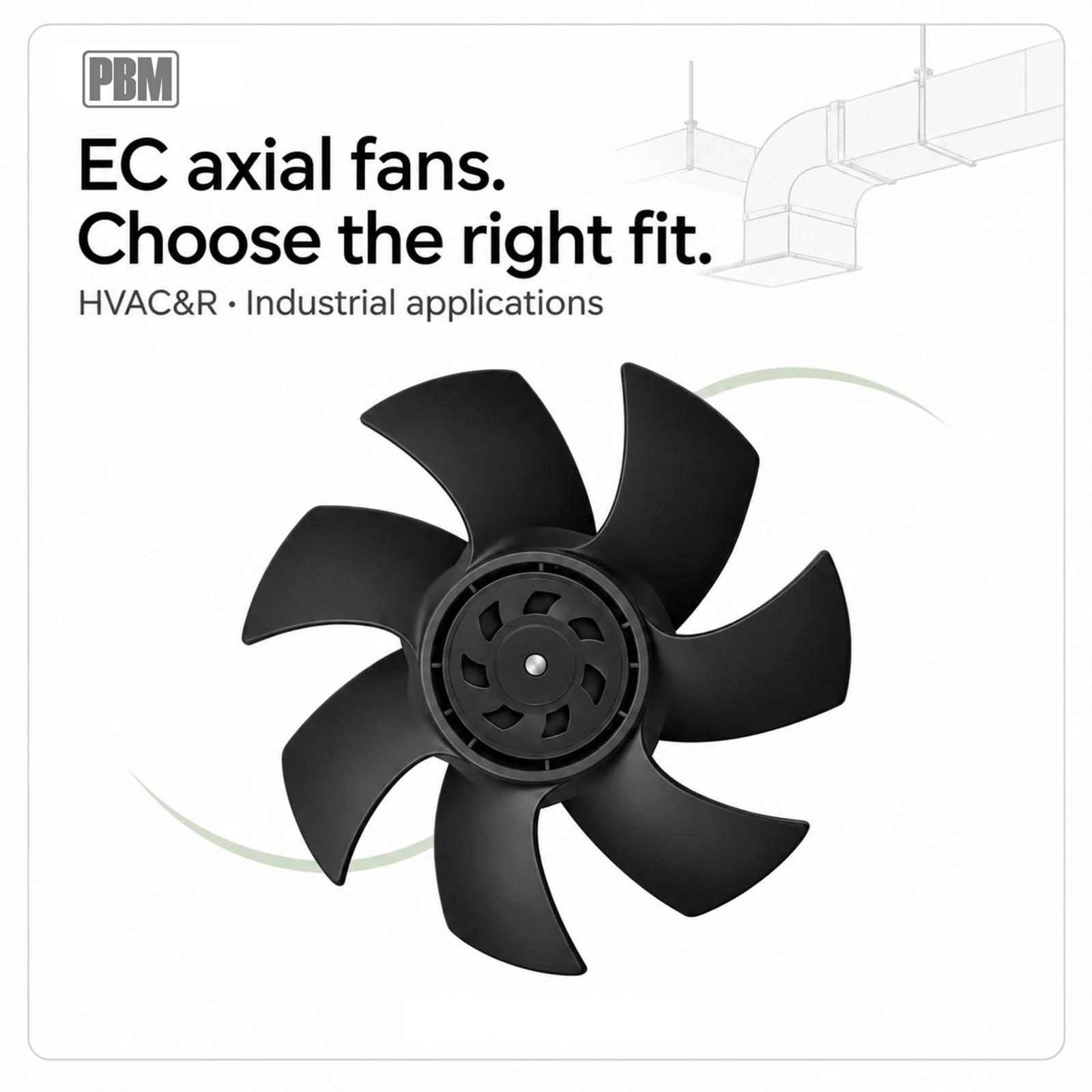
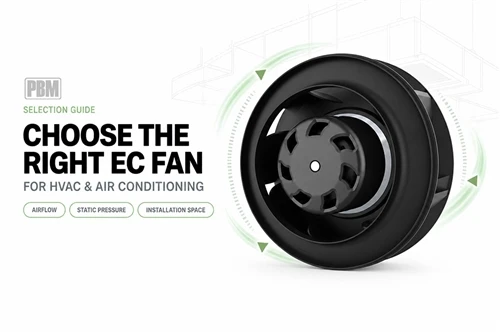
Axial fans play an essential role in HVAC&R systems, industrial ventilation, refrigeration equipment, and electronic cooling applications. By moving air in a direction parallel to the fan's rotational axis, axial fans provide effective airflow in applications where compact installation and efficient heat dissipation are important.
As energy efficiency becomes increasingly important, EC axial fans are gaining attention among equipment manufacturers and ventilation system designers. Combining electronically commutated motor technology with optimized fan designs, EC axial fans offer flexible speed control and efficient operation under suitable conditions.
However, selecting the right EC axial fan requires more than choosing a fan based on its diameter or maximum airflow.
This guide explains the key factors to consider when selecting an EC axial fan and introduces several PBM axial fan models for different HVAC&R and industrial applications.
1. Understanding EC Axial Fan Technology
An EC axial fan combines an electronically commutated motor with an axial impeller to generate airflow along the fan's rotational axis.
Unlike conventional fixed-speed AC fan solutions, EC fans use electronic motor control to regulate operation.
Depending on the model, EC axial fans can provide adjustable speed control, allowing airflow to respond to changing cooling and ventilation requirements.
Key Advantages of EC Axial Fans
Energy Efficiency
EC motor technology can reduce electrical losses and improve operating efficiency compared with certain conventional motor solutions.
Actual energy savings depend on the fan design, operating point, control method, and system requirements.
Adjustable Speed Control
EC axial fans can regulate motor speed to match changing airflow requirements.
This capability is particularly useful in applications where cooling demand varies throughout the day.
Compact Installation
Axial fan configurations can provide effective airflow within relatively compact equipment spaces.
Flexible Applications
EC axial fans can be integrated into HVAC equipment, refrigeration systems, industrial ventilation units, and electronic cooling applications.
Reliable Operation
Appropriate motor protection, bearing selection, and thermal management can support stable operation over extended periods.
2. Determine the Required Airflow and Static Pressure
Airflow and static pressure are two essential parameters when selecting an axial fan.
Airflow refers to the volume of air moved by a fan over a given period, typically expressed in cubic meters per hour (m³/h) or cubic feet per minute (CFM).
Static Pressure describes the pressure available to overcome resistance within the ventilation or cooling system. It is commonly expressed in Pascals (Pa).
A fan's actual operating point is determined by the intersection of its performance curve and the system resistance curve.
Therefore, maximum airflow and maximum static pressure should not be interpreted as values that necessarily occur simultaneously.
For example, an axial fan may deliver a high airflow rate under low-resistance conditions, while its airflow decreases as system resistance increases.
When selecting an EC axial fan, engineers should evaluate:
Required operating airflow
System resistance
Fan performance curves
Installation conditions
Power consumption
Noise requirements
Selecting a fan based on its actual operating point helps improve system efficiency and reliability.
3. Choose the Appropriate Voltage and Motor Configuration
EC axial fans are available in different electrical configurations to meet specific equipment requirements.
Some applications use AC-powered EC fans, while others require low-voltage DC-powered fan solutions.
The appropriate configuration depends on the equipment's power supply, control system, and operating environment.
AC-Powered EC Axial Fans
AC-powered EC axial fans can be suitable for HVAC&R equipment and industrial systems with compatible AC power supplies.
For example, the PBM PA3N200B2EH is a 200mm EC axial fan designed for applications such as electrical control cabinets, UPS systems, and industrial equipment cooling.
According to PBM's published product specifications, this model features:
Rated voltage: 230VAC
Rated power: 70W
Rated speed: 3,200 RPM
Published airflow: 1,160m³/h
Published static pressure: 320Pa
Protection rating: IP44
The model also supports 0–10VDC/PWM speed control, allowing airflow adjustment according to system requirements.
Its compact configuration makes it a potential option for equipment cooling applications where controlled airflow is required.
DC-Powered Axial Fans
Low-voltage DC-powered axial fans are commonly considered for applications involving DC power systems, electronic equipment, and industrial control cabinets.
The PBM PA3N215B24M is a 215mm axial fan designed for 24VDC applications.
Its published specifications include:
Rated voltage: 24VDC
Rated power: 62.4W
Rated speed: 2,000 RPM
Published airflow: 1,230m³/h
Published static pressure: 180Pa
Protection rating: IP44
Potential applications include industrial control cabinets, UPS equipment, energy storage systems, and other equipment requiring controlled ventilation.
When comparing AC-powered and DC-powered axial fans, customers should consider electrical compatibility, control requirements, installation dimensions, and expected operating conditions.
4. Consider Environmental Protection Requirements
Operating environments can significantly influence axial fan selection.
In applications exposed to dust, humidity, or water spray, the required ingress protection rating should be evaluated carefully.
IP ratings describe the degree of protection provided by an enclosure against solid objects and water ingress.
For example, IP55 indicates dust-protected construction and protection against water jets under specified test conditions.
However, IP55 does not mean that a product is completely waterproof or suitable for immersion.
Customers should also confirm whether the stated IP rating applies to the complete fan assembly or only to specific components.
PBM IP55 Axial Fan for Industrial Ventilation
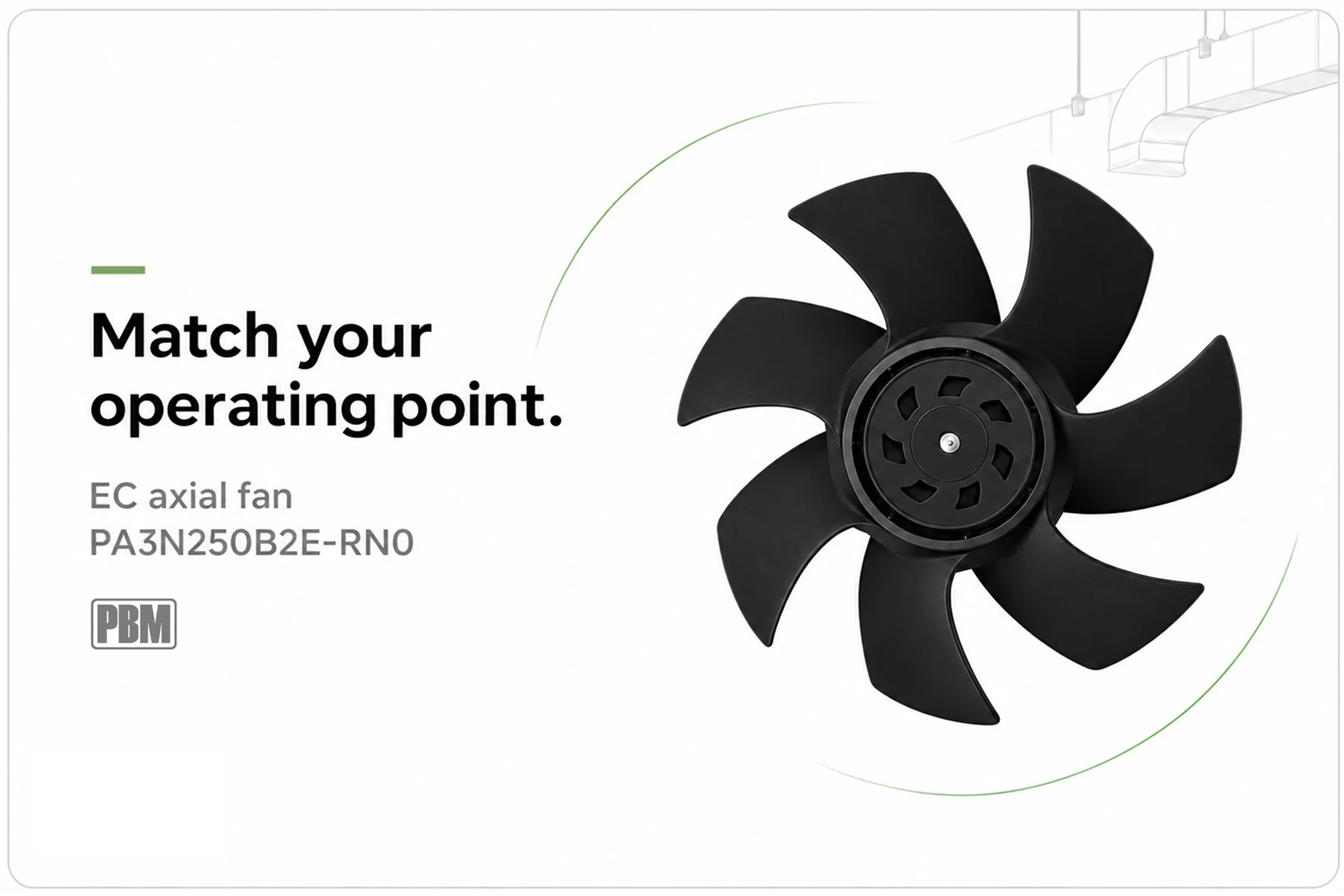
The PBM PA3N250B2E-RN0 is a 250mm EC axial fan designed for applications requiring environmental protection.
According to PBM's published product information, the model operates at 230VAC and provides:
Rated speed: 2,600 RPM
Published airflow: 1,700m³/h
Published static pressure: 210Pa
IP55 protection rating
Potential applications include greenhouse ventilation, industrial ventilation equipment, and HVAC systems.
For applications involving humidity, condensation, or airborne particles, engineers should evaluate the complete operating environment before selecting a fan.
5. Select Axial Fans Based on Application Requirements
Different industries require different airflow characteristics, electrical configurations, and installation arrangements.
HVAC&R Equipment
In heating, ventilation, air conditioning, and refrigeration systems, axial fans are commonly used to support airflow through heat exchangers and other equipment.
Selection should consider airflow requirements, system resistance, operating temperature, and available installation space.
Industrial Ventilation
Industrial ventilation equipment may require continuous airflow to remove excess heat and support suitable operating conditions.
Fan selection should consider operating hours, environmental exposure, and maintenance accessibility.
Electrical Cabinet Cooling
Electrical cabinets and industrial control systems often contain components that generate heat during operation.
Compact axial fans can support ventilation and heat dissipation when correctly integrated into the equipment.
The PBM PA3N200B2EH and PA3N215B24M are examples of axial fans that may be considered for suitable cabinet cooling applications.
Greenhouse Ventilation
Greenhouse ventilation systems require airflow to help regulate temperature and humidity.
For these applications, environmental protection and operating conditions are important considerations.
The PBM PA3N250B2E-RN0 is one example of an IP55-rated EC axial fan intended for demanding ventilation environments.
Industrial Cooling Equipment
Industrial cooling systems may require fans capable of operating under changing thermal loads.
An EC axial fan with suitable speed control can help adjust airflow according to equipment requirements.
6. Evaluate Fan Dimensions and Installation Conditions
Selecting the correct fan diameter is only one part of the installation process.
Engineers should also evaluate:
Overall fan dimensions
Mounting hole positions
Installation depth
Airflow direction
Electrical connection requirements
Protective guards
Available clearance
Maintenance accessibility
Insufficient installation clearance or poorly designed airflow paths can increase system resistance and reduce actual fan performance.
Before selecting a model, customers should review the manufacturer's dimensional drawings and installation instructions.
7. Compare Energy Efficiency and Operating Costs
For equipment operating continuously, electricity consumption can represent a significant portion of total operating costs.
EC axial fans can provide advantages in applications where airflow requirements vary and motor speed can be adjusted accordingly.
However, the potential energy savings should be evaluated using actual operating conditions.
A practical comparison should consider:
Fan input power at the required operating point
Daily operating hours
Annual operating days
Electricity costs
Maintenance requirements
Expected equipment service life
For example, reducing fan power consumption by 20W during 6,000 annual operating hours would save approximately 120kWh of electricity per year.
This is an illustrative calculation rather than a performance claim for a specific PBM product.
Actual savings depend on the selected fan and system operating conditions.
8. PBM EC Axial Fan Solutions
PBM Motor and Fan (Suzhou) Co., Ltd. focuses on EC fan technology and provides airflow solutions for HVAC&R, refrigeration, industrial ventilation, and equipment cooling applications.
PBM's axial fan product range includes different diameters, voltage configurations, airflow capacities, and environmental protection options.
For example:
PA3N200B2EH - 200mm EC Axial Fan
A 230VAC axial fan suitable for evaluating electrical cabinet and industrial equipment cooling applications.
PA3N215B24M - 215mm DC-Powered Axial Fan
A 24VDC model for applications such as industrial control cabinets, UPS systems, and equipment ventilation.
PA3N250B2E-RN0 - 250mm IP55 EC Axial Fan
A 230VAC model intended for applications requiring higher environmental protection, including greenhouse and industrial ventilation equipment.
PA3N250B24-RN0 - 250mm IP55 DC-Powered Axial Fan
A 24VDC axial fan option for compatible HVAC and industrial ventilation applications requiring dust and water ingress protection.
These models illustrate how different electrical configurations, dimensions, and protection ratings can support different application requirements.
Customers should consult the latest product specifications and performance curves before finalizing a selection.
9. How to Choose the Right EC Axial Fan Manufacturer
When selecting an EC axial fan manufacturer, product performance should be considered alongside technical support and manufacturing capabilities.
Important evaluation factors include:
Product Range
Does the manufacturer offer suitable fan dimensions, voltage configurations, and performance options?
Technical Documentation
Are product specifications, dimensional drawings, and performance curves available?
Application Support
Can the manufacturer help evaluate airflow, static pressure, electrical requirements, and installation conditions?
Quality and Reliability
Are the fan's materials, motor protection, bearings, and operating limits appropriate for the intended application?
Customization Requirements
Can the manufacturer discuss application-specific configurations when standard models do not meet project requirements?
Evaluating these factors helps customers select suitable products and reduce the risk of installation or performance problems.
10. Conclusion
Choosing the right EC axial fan requires a clear understanding of airflow requirements, static pressure, electrical specifications, environmental conditions, and installation constraints.
EC motor technology can provide valuable benefits for applications requiring adjustable airflow and efficient operation.
However, the most suitable fan is not necessarily the model with the highest maximum airflow or the largest diameter.
The correct selection depends on matching fan performance with actual system requirements.
PBM offers a range of EC axial fan solutions for HVAC&R, industrial ventilation, refrigeration, and equipment cooling applications.
Looking for a suitable EC axial fan for your next project?
Explore PBM's axial fan product range or contact our team to discuss your application requirements.
PBM - Delivering Integrated EC Fan Solutions for HVAC&R.