FOCUS ON EC FAN ONLY

Related Acessaries, Technical Features Overview

Maximized system efficiency and reduced airflow loss.

PBM offers a full range of accessories—inlet rings, fan controllers, and air-guiding wind deflector domes—supporting multi-directional installation for various space-constrained environments.Inlet rings feature streamlined contours to reduce turbulence losses; controllers provide stepless speed regulation, temperature-linked control, and alarm feedback; CFD-optimized deflector domes recover outlet dynamic pressure to cut energy consumption.

For durability, inlet rings are available in galvanized steel, stainless steel, or engineering plastics, while deflector domes use aluminum alloy or reinforced composites.Surface treatments include electro-galvanizing, powder coating, and anodizing, ensuring reliable performance in humid, high-temperature, or dusty conditions.

For system integration, all accessories are compatible with PBM's EC motor technology and both AC/DC power supplies. Controllers support RS485 (Modbus RTU) for remote monitoring, speed adjustment, fault diagnosis, and data acquisition, enabling seamless connection to IoE, IoT, smart building systems, and Industry 4.0 platforms. Intelligent regulation reduces overall energy consumption and supports carbon reduction and sustainability goals.
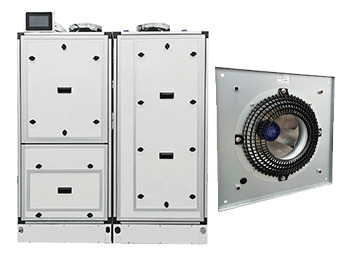
Forward Curved Centrifugal Fan

Optimized Performance, Minimal Loss: Streamlined inlet rings reduce turbulence; CFD-optimized domes recover dynamic pressure.

Flexible Mounting, Wide Adaptability: Supports vertical, horizontal, angled installation for any space constraints.

Durable Materials, Reliable in Harsh Conditions: Galvanized steel, stainless steel, or composites with anti-corrosion coatings for long service life.

Smart Integration, Industry 4.0 Ready: EC-compatible, AC/DC support, RS485 (Modbus RTU) for remote control and data acquisition.

Energy Efficient, Carbon Neutrality Support: Intelligent control cuts energy use. Optional PFC (λ>96%) for grid stability.

Application

Air Handling Unit (AHU)

Air-Purifiers
Reduced Vortex Loss, Lower System Resistance – Smoothly transitions airflow from impeller to duct, eliminating turbulence and cutting local resistance for efficient AHU operation.

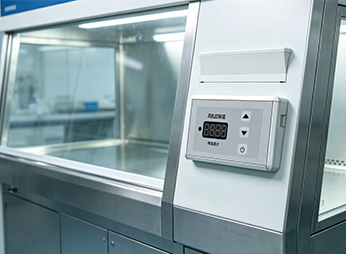
Laboratory and Analytical Equipment

IT-and-Electronic-Industry
Precise Environmental Control for Reproducibility – Closed-loop regulation of temperature, humidity, pressure, and airflow ensures stable chamber conditions—the cornerstone of repeatable scientific results.

Mechanical Equipment

Medical-Industry
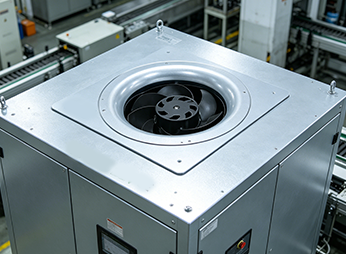
Optimized Airflow, Reduced Turbulence – Streamlined inlet ring ensures smooth, uniform entry into impeller, eliminating vortex losses and boosting fan aerodynamic efficiency.

FAQ

  • How does an inlet ring improve fan efficiency?

    +
    An inlet ring improves fan efficiency through aerodynamic optimization of the intake flow path. Without an inlet ring, air entering the impeller experiences abrupt directional changes and separation losses, which reduce the fan's ability to convert mechanical energy into useful airflow. The inlet ring acts as a nozzle, gradually accelerating the air and creating a uniform velocity profile at the impeller eye. This reduces incidence losses at the blade leading edges and minimizes recirculation. In PBM's internal testing, properly matched inlet rings contribute to maintaining the fan's peak efficiency across the operating range, directly supporting the energy savings that EC technology is known for — our EC motors already achieve efficiency up to 91%, and the inlet ring ensures that motor efficiency translates into actual system performance.
  • How do I select the correct inlet ring for my PBM fan?

    +
    Selecting the right inlet ring involves three considerations:
    • Impeller diameter match: The inlet ring throat diameter must match the impeller eye diameter. PBM designs each inlet ring specifically for its corresponding impeller size (e.g., 133mm, 175mm, 190mm, 220mm, 250mm, 280mm, 310mm, 355mm, 400mm, 450mm, 500mm, 560mm).
    • Mounting configuration: Determine whether the inlet ring requires a flange mount, bolt-on attachment, or press-fit into your equipment panel. PBM can advise on the correct mounting bracket or adapter based on your application.
    • Instrumentation needs: Decide if you need a standard ring or an instrumented version with pressure taps.
    Contact PBM with your fan model number and application details, and we will specify the correct inlet ring part number for your setup.
  • What type of speed control does PBM's EC fan controller support?

    +
    PBM's EC fans are designed with integrated electronic control circuits that support two standard analog control signals: 0–10 VDC and PWM (Pulse Width Modulation). Our fan controllers use a 10K Ohm potentiometer to generate a variable 0–10 VDC control signal, allowing stepless (continuous) speed adjustment from minimum to maximum. This is the industry-standard control method for EC fans and is compatible with all PBM EC and DC fans that feature speed control input terminals. The controller also includes an ON/OFF switch integrated into the rotary knob for convenient local operation. For customers who need remote or automated control, our fans also support RS485/MODBUS communication protocol — compatible with IoT, smart building systems, and Industry 4.0 architectures.
  • How much noise reduction can I expect from using a FlowGrid grille?

    +
    The actual noise reduction depends on the fan type, operating point, and system configuration. Based on published test data from industry-standard installations:
    • Centrifugal fans in air conditioners: Blade passing noise can be reduced by up to 9 dB, and overall noise level by up to 3.3 dB(A)
    • Axial fans with HyBlade technology in heat pumps: Blade passing noise reduction of up to 12 dB has been measured
    • Condenser applications: Noise level reductions of up to 16 dB for blade passing noise were observed in tests
    • Air purifiers (RadiCal + FlowGrid combo): Overall noise level reduction of 2.8 dB(A) with blade passing noise down by 10 dB
    To put this in perspective: a 10 dB reduction in perceived noise represents approximately a 50% reduction in perceived loudness. For B2B equipment manufacturers, this can make the difference between meeting or failing local noise regulations (such as EU outdoor noise directives) without expensive additional soundproofing.
  • What applications benefit most from using a FlowGrid grille?

    +

    An inline fan is a type of duct fan installed directly inside the duct system. In many applications, the terms "inline fan" and "duct fan" are used interchangeably.

    However, “duct fan” is a broader category that may include:

    • The FlowGrid is most beneficial in applications where noise compliance is a critical requirement. The top applications include:
    • Heat pumps (air-to-water, air-to-air): Often installed in residential gardens or near property boundaries, strict night-time noise limits make FlowGrid very valuable
    • Condensers and refrigeration units: Supermarket condensers and cold storage units frequently face neighbor noise complaints
    • Commercial air conditioning: Rooftop units, cassette units, and central AC systems in commercial buildings
    • Ventilation systems: Industrial and commercial ventilation where fans operate continuously near occupied spaces
    • Air purifiers: For indoor air quality equipment in offices, hospitals, and clean rooms where low noise is expected
    • IT and data center cooling: Server room cooling fans that run 24/7 and need to maintain acceptable noise levels
    All of these align directly with PBM's target application markets, including Ventilation & Purification, Air Conditioning, Cold Storage & Cold Chain, and IT & Electronics Industry.

We are here to help

captcha
×

Contact Us

captcha
×

Inquire

*Name
*Email
Company Name
Tel
*Message
*Verify Code
captcha

By continuing to use the site you agree to our privacy policy Terms and Conditions.

I agree