FOCUS ON EC FAN ONLY
FOCUS ON EC FAN ONLY
Low-noise ventilation isn’t just a comfort feature — it impacts productivity, compliance and system acceptance. In offices, clinics, hotel rooms and studios, noisy fans create distraction and complaints. In data centers or medical spaces, noise can mask alarms or indicate mechanical issues. Choosing the right low-noise fan reduces service calls, improves occupant satisfaction, and shortens installation rework.
Sound level (dB(A)) — decibel A-weighted. Lower is quieter. Important for machine-room and public spaces.
Sone — a perceptual unit; 1 sone ≈ quiet refrigerator hum. Sone maps more directly to perceived loudness than dB.
CFM (cubic feet per minute) — airflow. Size the fan to deliver required CFM for your space.
Static pressure (in. w.g. or Pa) — resistance the fan must overcome (ducts/grilles/filter). Higher static pressure needs fans designed for it.
Efficiency (CFM/W) — airflow per watt; critical for continuous run systems (attics, data closets).
IP / material / duty cycle — environment protection (water/dust), motor class and continuous rating.
You must size fans for airflow requirements, not noise alone.
ACH (air changes per hour) = target ventilation rate (typical ranges: bedrooms 4–6 ACH, offices 4–8 ACH, bathrooms/exhaust higher).
Volume (ft³) = length × width × height (feet).
Required CFM = (Volume × ACH) / 60.
Example (bedroom):
Room = 12 ft × 10 ft × 8 ft → Volume = 12×10×8 = 960 ft³.
Desired ACH = 6 → Required CFM = (960 × 6) / 60 = 5760 / 60 = 96 CFM.
Always add a contingency buffer (10–25%) if filters, bends or long ducts create extra losses.
| Fan type | Typical noise profile | Best for | Notes for low-noise selection |
|---|---|---|---|
| Axial Fan (propeller) | Low–moderate | Large-volume, low-static ducts (warehouse intake) | Choose well-balanced blades, variable speed drives (VFD) and anti-vibration mounts |
| Backward Curved Centrifugal | Low at mid-pressure | Ducted systems with moderate static | Good efficiency and quieter at design point vs forward curved |
| Forward Curved Centrifugal | Moderate | Low pressure HVAC blowers (compact units) | Can be quieter at low speeds but less efficient at higher loads |
| Mixed-flow / Inline | Moderate–low | Inline duct booster for bathrooms/greenhouses | Good compromise CFM vs pressure with lower noise if ducted well |
| Cross-flow (tangential) | Low, wide shallow flow | Diffuse, even flow for enclosures, appliances | Very quiet in small-room / appliance use |
| Plenum / Plug fans (EC motor) | Low (excellent control) | AHUs and systems needing VAV | EC motors + PWM control = best quiet performance & efficiency |
Rule: For low noise in ducted installations, locate the fan in a sound-isolated plenum, use long gradual bends, and avoid placing the fan directly against lightweight panels.
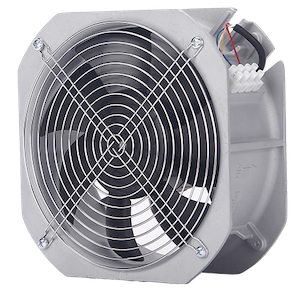
EC (electronically commutated) motors: quieter, more efficient, excellent variable-speed control. Best choice where noise and energy matter.
AC motors with VFD or multi-speed: acceptable if VFD is properly tuned; beware of motor-drive tonal noise.
Sound from motors often dominates at low frequencies — choose motors with good bearings (sealed ball bearings), thermal protection, and balanced rotors.
Tip: Use soft-start control and PWM modulation outside audible frequency ranges to avoid whine.
Vibration isolation: rubber mounts, neoprene pads, spring hangers. Isolate fan housing from building structure.
Flexible connectors: between fan and duct to break vibration transmission.
Acoustic lining / silencers: inlet/outlet silencers, acoustic lining in ducts for broadband noise.
Duct design: avoid sharp elbows; use long gradual bends and wide radii to reduce turbulence noise.
Grilles and diffusers: use multi-cell diffusers or sound attenuating grilles to break tonal peaks.
Maintenance access: schedule balancing and lubrication — unbalanced impellers increase noise dramatically over time.
Office / Conference Room / Bedroom: cross-flow or inline mixed-flow in ducted ceiling systems; EC motor, sone <1.5 target; anti-vibration mounting.
Data cabinet / IT closet: high CFM per kW cooling requirement; choose backward-curved centrifugal with high static capability, redundant fans and monitoring for bearing noise.
Medical examination rooms / Clinics: low noise priority + controlled airflow — EC plug fan or backward-curved centrifugal with HEPA prefilter and quiet enclosure.
Cold storage / cold chain: fans rated for low temp, IP55 where necessary; slower rotational speeds reduce noise but keep CFM via larger diameter impellers.
Household appliances (built-in range hood, laundry): cross-flow or small centrifugal with sound-attenuating housings and low sone ratings.
Required CFM @ specified static pressure (in. w.g / Pa) — provide ductwork resistance curve.
Maximum allowable noise level (dB(A) at 1 m or sone at typical mounting).
Motor type & supply voltage (EC preferred; list voltage/frequency).
Duty cycle / ambient temperature / humidity / IP rating.
Mounting method & available space (dimensions, orientation).
Weight & vibration limits for mounting structure.
Certifications required (CE, RoHS, ETL, UL for North America).
Spare parts & lead time / MOQ / warranty terms.
Test reports: sound power Lw, measured dB(A) at distances, 3rd-party balancing certificate.
Sound report showing dB(A) at 1 m and 3 m, with measurement distance and background noise.
Static pressure curve and system curve overlay (so you can verify operating point).
Vibration measurement (mm/s or ISO standard) at mounting points.
Endurance/runtime test for continuous operation if needed.
Add flexible duct connectors and anti-vibration mounts.
Move the fan further from sensitive spaces (use longer duct + silencer).
Replace AC motor with EC motor & add VFD for speed control.
Ensure impeller balancing and periodic maintenance.
Subject: Request for Quotation — Low-Noise Ventilation Fan (CFM / SP / Noise Spec)
Hello,
We require a ventilation fan for [APPLICATION] with the following: [REQUIRED CFM] at [STATIC PRESSURE], noise ≤ [dB(A)@1m or sone], motor type: [EC/AC], supply: [V, Hz], IP rating: [IP55], mounting: [wall/ceiling/inline], certifications: [CE/UL]. Please provide data sheets, acoustic report, warranty terms, MOQ and lead time.
Thanks,
[Your name / procurement team]
Q: Is dB or sone better to specify?
A: Specify both if possible. dB(A) is standard for measurement; sone gives better sense of perceived loudness.
Q: Can I make any fan “quiet” by slowing it down?
A: Slowing reduces noise, but also reduces CFM. Better to choose a fan sized with low RPM and larger impeller or an EC motor with VSD.
Q: Are EC motors always the best?
A: For low-noise and energy efficiency, yes — but cost and supply constraints may favor AC with a well-tuned VFD in some projects.
Choosing the right low-noise ventilation fan is a balance of acoustics, airflow, static pressure and installation. For B2B procurement, the most important steps are: define target CFM at system static pressure, state maximum noise limits, request third-party acoustic tests, and insist on EC motor options for continuous, quiet operation.
If you’d like, I can:
generate a spec sheet template you can send to suppliers, or
produce H2/H3 content outlines for three selected topics (e.g., Office Fans, Data Rack Cooling, Cold Storage Fans) based on this guide — ready to paste into your CMS.
 If you have any interest in our products,please feel free to contact us & we are ready to serve you

By continuing to use the site you agree to our privacy policy Terms and Conditions.