FOCUS ON EC FAN ONLY
FOCUS ON EC FAN ONLY
Axial fans are widely used for various ventilation and cooling applications due to their ability to move large volumes of air with low to moderate resistance. These fans come in different types, each designed to address specific needs and environmental conditions. Understanding the different types of axial fans can help you choose the right one for your application, whether it's for industrial use, residential cooling, or specific high-performance needs.
In this guide, we’ll explore the main types of axial fans, their unique features, advantages, limitations, and ideal use cases.
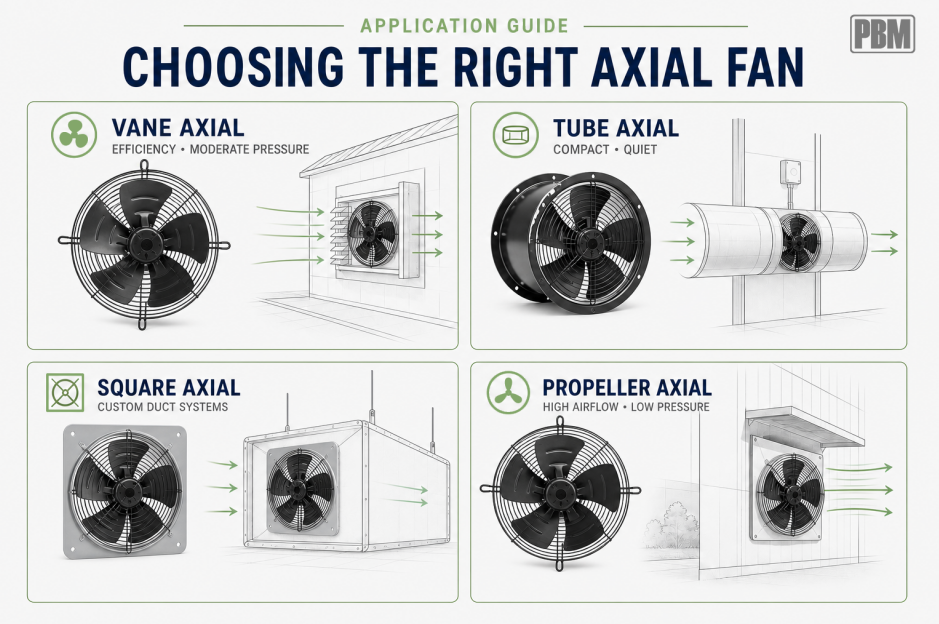
A vane axial fan consists of blades mounted on a rotor, with stationary vanes that direct the airflow in a uniform direction. The vanes reduce turbulence and increase the fan's efficiency by straightening the airflow after it leaves the blades.
Increased Efficiency: Vane axial fans are designed for higher efficiency due to the incorporation of vanes that guide the airflow.
High-Flow, Low-Pressure: These fans are suitable for applications that require large airflow at lower pressures.
Energy Efficient: The vanes help reduce turbulence and losses, making the fan more energy-efficient compared to standard axial fans.
HVAC Systems: Vane axial fans are often used in air handling units to move large volumes of air.
Cooling Systems: Ideal for cooling towers and process cooling where high airflow and efficiency are required.
Industrial Ventilation: Used in factories and warehouses where moderate air pressure is needed for ventilation.
Enhanced performance and energy efficiency.
Suitable for moderate pressure applications.
Provides stable and uniform airflow.
Not suitable for high-pressure environments.
Can be larger and heavier than non-vane axial fans, which might limit installation options in confined spaces.
A tube axial fan is a type of axial fan where the rotor (fan blades) is housed within a cylindrical tube. The design allows for a more compact structure while providing efficient airflow over longer distances.
Compact Design: The cylindrical tube housing provides structural stability while saving space.
Quiet Operation: Tube axial fans tend to operate with lower noise levels compared to other industrial fans.
Versatile Installation: Ideal for applications where space constraints exist or for integrating into existing ductwork systems.
Ventilation Systems: Widely used in HVAC applications where space-saving is a priority.
Industrial Cooling: Suitable for cooling and exhaust in environments like warehouses, factories, and large commercial spaces.
Air Circulation: Often used for air circulation in closed spaces such as data centers and server rooms.
Quiet operation makes them ideal for noise-sensitive environments.
Compact and easy to integrate into systems with limited space.
Suitable for both industrial and commercial ventilation needs.
May not be as efficient as other axial fan types for moving high volumes of air over long distances.
Can struggle with high-pressure environments due to the design constraints.
A square axial fan is an axial fan that is designed in a square frame instead of a round one. It is typically used for applications that require the fan to be mounted in a square or rectangular duct, making it easier to integrate into custom ventilation systems.
Space-Saving Design: The square shape is ideal for integrating into ducts and installations where a round fan might not fit.
Flexible Airflow Direction: Square axial fans can often be mounted at any angle, making them versatile in ventilation systems.
Increased Durability: The square frame can offer added protection against environmental elements and is often used in harsh conditions.
Ducted Ventilation Systems: Perfect for use in industrial ventilation systems where the fan needs to fit into rectangular or square ductwork.
Residential and Commercial HVAC: Used in air conditioning and heating systems, especially where space is tight.
Exhaust Fans: Common in systems that require directed airflow through compact spaces.
Ideal for custom installations with square or rectangular duct systems.
Provides strong airflow at lower pressure levels.
Easily integrated into complex ventilation systems.
Can be bulkier and heavier compared to round axial fans.
Not as efficient for high-pressure or long-distance ventilation.
A propeller axial fan uses large blades, similar to those of a propeller, to move air through the system. These fans are typically used for low-pressure applications where large volumes of air need to be moved over shorter distances.
High Airflow: Propeller fans are designed to move large volumes of air with relatively low energy consumption.
Simple Design: The design is straightforward, with blades attached directly to the motor shaft, making it easy to manufacture and maintain.
Low Maintenance: With fewer components, propeller fans require less maintenance compared to other fan types.
General Ventilation: Commonly used for ventilating warehouses, large offices, and factory floors.
Exhaust Systems: Often used in exhaust fans for industrial settings where high airflow is necessary but pressure is not a concern.
Cooling Systems: Used in cooling towers and other cooling applications that require high-volume air movement.
Cost-effective for large-volume airflow needs.
Reliable and low maintenance.
Works efficiently in low-pressure conditions.
Limited use in high-pressure environments.
Can be noisy depending on the design, especially in industrial applications.
| Type of Fan | Best Use Case | Advantages | Limitations |
|---|---|---|---|
| Vane Axial Fan | High-efficiency, moderate-pressure applications | Increased efficiency, energy-saving, stable airflow | Not suited for high-pressure environments |
| Tube Axial Fan | Space-constrained applications, quiet environments | Compact, quiet, versatile for tight spaces | Less efficient for high-pressure applications |
| Square Axial Fan | Custom ducted systems, tight spaces | Fits in square ducts, durable, versatile | Bulky, not ideal for high-pressure conditions |
| Propeller Axial Fan | General ventilation, exhaust systems | High airflow, low maintenance, cost-effective | Limited efficiency in high-pressure applications |
Choosing the best axial fan depends largely on the specific requirements of your space and application. If you need high-efficiency airflow with minimal pressure, a vane axial fan is ideal. For environments where space is limited, tube axial fans are a great choice. If you need a fan for ducted systems, square axial fans provide the flexibility to fit custom configurations. Lastly, propeller axial fans offer an economical solution for general ventilation and exhaust needs.
Consider your specific airflow, pressure, space, and efficiency needs to determine which fan type will best serve your purposes. Each of these axial fan types provides unique benefits that cater to a wide range of ventilation, cooling, and exhaust applications.
 If you have any interest in our products,please feel free to contact us & we are ready to serve you

By continuing to use the site you agree to our privacy policy Terms and Conditions.