

All Rights Reserved Privacy Policy Site Map
FOCUS ON EC FAN ONLY
FOCUS ON EC FAN ONLY
When selecting an axial fan for a specific application, it’s crucial to consider a variety of factors to ensure you get the best performance, energy efficiency, and reliability. Axial fans are versatile, used in a range of industries from HVAC systems to industrial cooling. But choosing the right fan can be daunting with the variety of models available in the market. This guide will walk you through the key axial fan specifications you need to know to make an informed decision based on your unique needs.
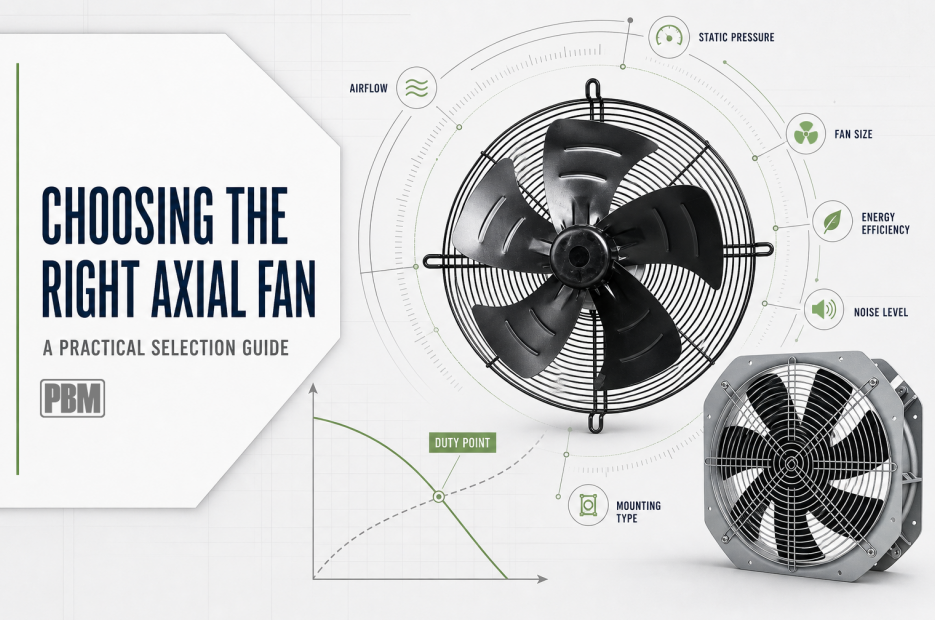
An axial fan is a type of fan where the airflow is parallel to the axis of rotation. These fans consist of blades mounted on a rotating hub, which draws in air and pushes it out in the same direction. Axial fans are widely used for ventilation and cooling in both residential and industrial settings due to their simplicity, energy efficiency, and ability to move large volumes of air.
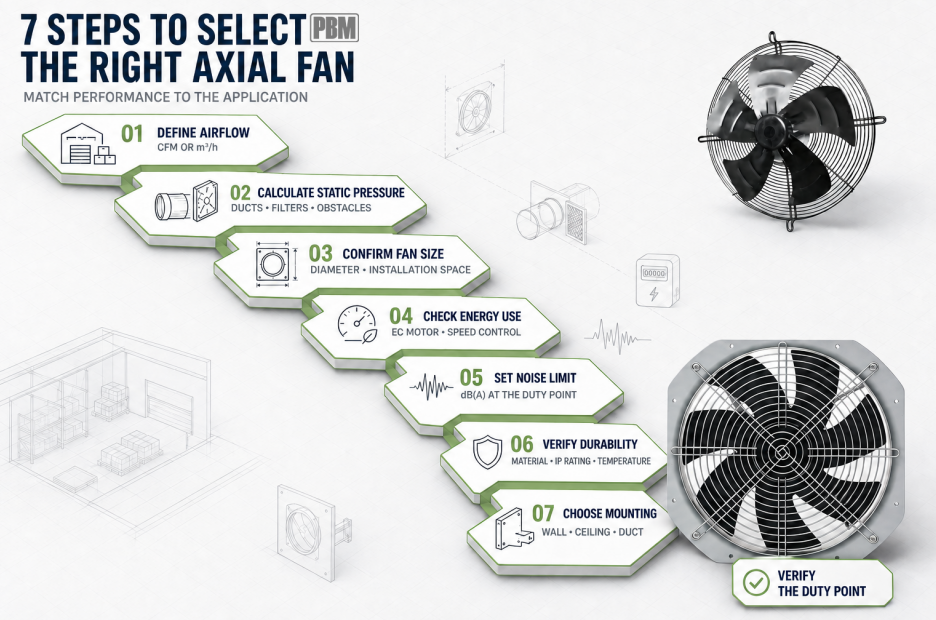
Selecting the right axial fan involves evaluating several performance characteristics to match the requirements of your application. Here’s a breakdown of the most important factors to consider:
One of the most important specifications when choosing an axial fan is airflow, which is typically measured in CFM. Airflow refers to the amount of air the fan moves per minute.
For residential applications: A lower CFM is often enough, such as for bathrooms, kitchens, or small offices.
For industrial use: Larger spaces like warehouses, factories, or data centers require higher CFM ratings to efficiently circulate air.
Tip: The required airflow depends on the volume of air you need to move, which is often calculated based on the room or space's square footage and the intended application.
While airflow is important, static pressure measures how much resistance the fan can overcome while moving air through ducts, filters, or other obstacles. Static pressure is typically measured in Pa (Pascal).
High static pressure fans are designed for spaces with restrictions such as long ducts, vents, or smaller openings.
Low static pressure fans are ideal for environments with minimal airflow obstruction, like open spaces or areas without ducts.
Tip: If your fan will be pushing air through ducts or over long distances, you’ll need a fan with higher static pressure capabilities.
The size of the axial fan impacts both its airflow and the space it occupies. Larger fans tend to move more air but require more space and may be louder than smaller fans. The number and design of blades also influence the fan's efficiency and noise level.
For smaller spaces: A fan with smaller diameter blades is preferable to save space.
For larger spaces: A larger fan with more blades is better suited to move large volumes of air.
Tip: When choosing fan size, consider both the physical dimensions of the fan and the airflow needed for your space.
Energy consumption is a key factor, especially for large-scale industrial applications where fans operate continuously. Opting for an energy-efficient axial fan can save significant costs over time. Look for fans that are designed with efficient motors and low-energy consumption features, which are ideal for green building or sustainable operations.
EC (Electronically Commutated) motors are typically more energy-efficient and reliable compared to traditional motors.
Fans with variable speed or smart controls can optimize energy use based on actual needs.
Tip: If energy efficiency is a priority, choose fans with EC motors and those that offer low power consumption but high airflow.
Noise can be a major consideration, especially for residential or commercial environments like offices or conference rooms. The noise level of an axial fan is generally measured in decibels (dB).
Low noise axial fans are ideal for applications requiring quiet environments, such as bedrooms, studios, or libraries.
High-performance fans might generate more noise but are essential for large spaces or industrial environments where noise isn’t a primary concern.
Tip: If noise is a concern, look for fans specifically labeled as "low noise" or those designed for quiet operation.
The material and build quality of an axial fan determine its longevity, especially in harsh industrial environments.
Metal blades are typically more durable and can handle high temperatures and heavy-duty use.
Plastic blades are lightweight and ideal for residential or low-demand applications but may not withstand harsh conditions as well as metal.
Tip: For harsh environments like chemical plants or factories, opt for fans with metal blades and corrosion-resistant coatings.
Axial fans come in various mounting configurations, such as wall-mounted, ceiling-mounted, or ducted models. Choose the one that fits your available space and installation needs.
Wall-mounted fans are ideal for spaces where ceiling mounting isn’t an option, such as narrow rooms or outdoor areas.
Ceiling-mounted fans are great for larger spaces and can save floor space while providing even airflow distribution.
Ducted fans are suited for applications where the fan needs to be integrated into an existing ventilation system.
Tip: Make sure the fan’s mounting options align with your space requirements and that it’s easy to install.
While axial fans are excellent for low-pressure, high-airflow applications, there are situations where a centrifugal fan may be a better choice. Centrifugal fans create higher pressures and are typically used in systems with more airflow resistance, such as systems with long ducts or multiple obstacles.
Large open spaces with minimal airflow resistance
Applications that require high airflow and low pressure, such as cooling systems and exhaust ventilation.
Systems with significant resistance to airflow, such as air conditioning ducts or systems with filters.
Selecting the right axial fan for your needs requires understanding your application, airflow requirements, and the specific environment in which the fan will operate. By considering factors such as airflow (CFM), static pressure, fan size, energy efficiency, and noise levels, you can choose the best fan that will provide optimal performance and long-term reliability. Whether you’re cooling a small office, ventilating a large industrial facility, or improving air quality in a greenhouse, the right axial fan can significantly enhance airflow, comfort, and energy efficiency.
Be sure to consult with experts or manufacturers to ensure that the axial fan you select meets all the technical specifications and requirements for your specific needs.
 If you have any interest in our products,please feel free to contact us & we are ready to serve you

By continuing to use the site you agree to our privacy policy Terms and Conditions.