FOCUS ON EC FAN ONLY
FOCUS ON EC FAN ONLY
When it comes to ventilation and air circulation, choosing the right type of fan can significantly impact the performance and efficiency of your system. Among the most common fan types are axial fans and centrifugal fans. While both serve the same basic function—moving air—they operate differently and are better suited for different applications.
In this article, we’ll compare axial fans to centrifugal fans based on their performance, efficiency, and ideal uses to help you understand which one is better for your specific needs.
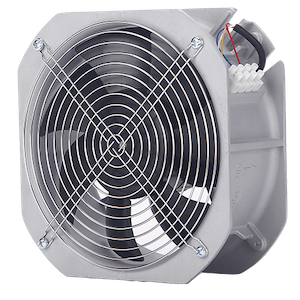
An axial fan is a type of fan where air flows parallel to the fan's axis. These fans have blades attached to a central hub that rotate, pushing air directly in and out along the same axis. They are often used for low-pressure, high-flow applications and are commonly found in ventilation systems, exhaust systems, and cooling applications.
Airflow Direction: Air moves parallel to the fan axis.
Design: Simple design with a set of blades rotating around a central hub.
Pressure: Generally suitable for low to medium pressure systems.
Efficiency: Best suited for applications requiring high airflow rates with relatively low resistance.
A centrifugal fan, on the other hand, uses centrifugal force to move air. The fan draws air into the center of the fan and then expels it at a 90-degree angle from the intake. Centrifugal fans are more complex and tend to generate higher pressures compared to axial fans. They are commonly used in systems requiring high pressure or to move air through long ducts or systems with significant resistance.
Airflow Direction: Air moves perpendicular to the fan's axis.
Design: More complex, with a set of blades that spin inside a housing or casing.
Pressure: Ideal for high-pressure applications.
Efficiency: Better suited for applications requiring high pressure and resistance to airflow.
To better understand which fan type is better, let’s break down the performance factors of airflow and pressure—the two most important aspects of fan performance.
Axial Fans: These fans are designed for high-volume airflow and are typically able to move large quantities of air at low pressure. They are ideal for applications where high airflow is needed without much resistance, such as in large ventilation systems, cooling towers, or exhaust systems.
Centrifugal Fans: These fans are more effective at handling lower airflow rates but at higher pressure levels. They can push air through narrow ducts or systems with higher resistance. Centrifugal fans are better suited for applications where airflow needs to overcome significant obstacles, like air conditioning systems, fume extractors, or industrial dust collection systems.
Verdict: If your primary need is to move large volumes of air with minimal resistance (e.g., ventilation in large spaces), an axial fan will be more suitable. However, for applications requiring air movement through ducts with higher pressure, such as industrial exhaust systems, a centrifugal fan is the better choice.
Axial Fans: These fans produce lower pressure and are generally more efficient in systems that don’t involve high resistance. They work best in open spaces with free-flowing air, such as cooling systems for electronics or large ventilation systems in commercial spaces.
Centrifugal Fans: These fans can generate higher pressure, making them more effective in systems where air needs to be pushed through long ducts or obstacles. They are typically used in systems with higher resistance, such as HVAC systems, industrial ventilation systems, or blowers for dust and fumes.
Verdict: Centrifugal fans are more efficient for high-pressure applications, while axial fans are ideal for low-pressure situations.
Axial Fans: These fans are more energy-efficient in applications requiring high airflow and low pressure. Because they move large amounts of air without much resistance, they don’t require as much power to operate. This makes them a more cost-effective choice for ventilation in environments like warehouses, large office buildings, and exhaust systems.
Centrifugal Fans: While centrifugal fans are effective at high pressure, they tend to be less energy-efficient than axial fans in applications that don’t require such high pressures. They need more power to overcome the resistance, and they tend to consume more energy in high-pressure systems like air conditioning units or industrial air filtration systems.
Verdict: Axial fans tend to be more energy-efficient in applications where large airflow is required at low pressure. Centrifugal fans, however, are necessary when higher pressure is needed, though they may consume more energy.
Axial Fans: Due to their simple design and low-pressure operation, axial fans are often quieter than centrifugal fans. The noise level of axial fans is generally lower, making them a better choice for environments where noise is a concern, such as office buildings, hospitals, or residential areas.
Centrifugal Fans: Centrifugal fans tend to generate more noise due to their more complex design and the higher pressure required to move air. The noise is typically higher because of the fan’s internal components, such as the housing and motor.
Verdict: Axial fans are quieter and more suited for applications where noise reduction is important. Centrifugal fans, on the other hand, are noisier due to their more complex operation.
Ventilation in large open spaces (warehouses, factories, buildings).
Exhaust systems for high-airflow, low-pressure applications (bathrooms, kitchens).
Cooling in large systems where airflow is critical (data centers, cooling towers).
Greenhouses and agricultural systems for maintaining airflow.
HVAC systems where air needs to be pushed through ducts with higher resistance.
Dust collection systems in industrial settings.
Fume extraction in factories and laboratories.
Air conditioning or refrigeration systems that require higher pressure.
The choice between axial fans and centrifugal fans ultimately depends on the specific needs of your application.
If you need high airflow with low resistance, such as in large open spaces or cooling systems, axial fans are the better choice. They are energy-efficient, quieter, and provide adequate performance for low-pressure environments.
If your system requires high pressure to push air through ducts or other obstacles, such as in HVAC systems or industrial ventilation, centrifugal fans are more suitable. They offer better performance in high-pressure systems but may come with higher energy consumption and more noise.
Ultimately, understanding the pressure requirements and airflow needs of your system will guide you in selecting the right fan for optimal performance, energy efficiency, and cost-effectiveness.
 If you have any interest in our products,please feel free to contact us & we are ready to serve you

By continuing to use the site you agree to our privacy policy Terms and Conditions.