

All Rights Reserved Privacy Policy Site Map
FOCUS ON EC FAN ONLY
FOCUS ON EC FAN ONLY
Axial fans are an essential component in various systems where airflow and ventilation are needed. Whether you're familiar with their use in HVAC systems, industrial settings, or even home appliances, axial fans serve a wide range of applications. In this article, we’ll explore the definition, working principles, types, and key applications of axial fans, as well as compare them with centrifugal fans to help you understand when each is best suited for different tasks.
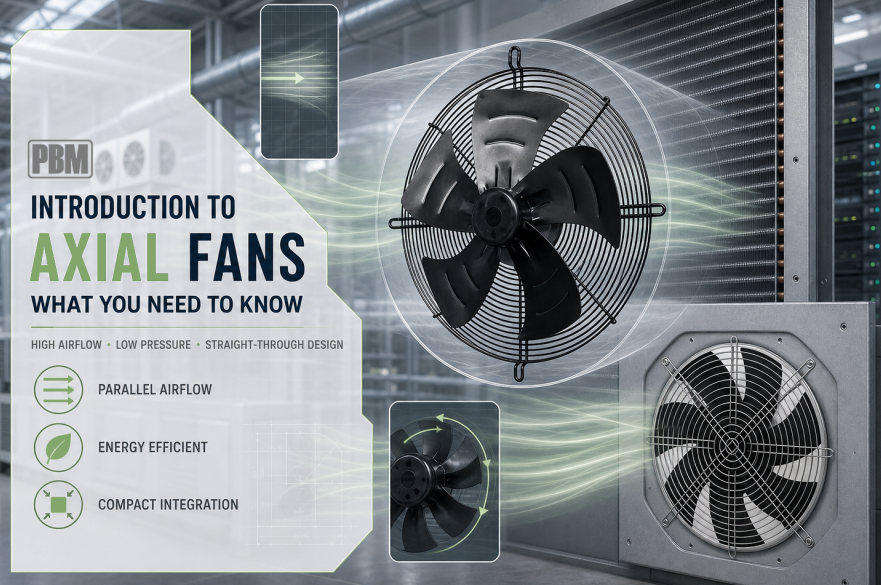
An axial fan is a type of fan that moves air along the axis of the fan. The airflow in an axial fan is parallel to the axis of rotation, which is achieved through the rotation of blades. These fans are known for their efficient airflow and low power consumption in specific applications, making them a popular choice in numerous industries.
Airflow Direction: Air flows parallel to the shaft (or axis) of the fan.
Design: They typically have blades that resemble the wings of an airplane, mounted around a central hub.
Speed: Axial fans usually operate at relatively high speeds, making them ideal for moving large volumes of air over short distances.
Energy Efficiency: Due to their design, axial fans are often energy-efficient in low-pressure applications.
The working principle of an axial fan is quite simple. The blades of the fan rotate around a central hub, creating a pressure difference that causes air to move through the system. The rotating blades force air to flow in a direction that is parallel to the axis of the fan’s rotation.
Blade Rotation: As the fan blades rotate, they impart kinetic energy to the air molecules, pushing the air in the same direction as the rotation.
Airflow: The airflow is directed straight through the fan, parallel to the axis of the motor.
Ventilation: The axial fan’s primary function is to move air, creating ventilation in confined spaces, or helping with cooling and heat dissipation in various systems.
Because the airflow in axial fans is linear, they excel at moving large volumes of air with relatively low pressure drops. This makes them especially suitable for applications where high airflow is more important than air pressure, such as cooling and exhaust systems.
Axial fans come in a variety of designs, each optimized for specific uses. Here are the most common types:
Design: These fans are installed within ductwork to push air through ventilation systems.
Applications: Commonly used in HVAC systems, greenhouses, and industrial ventilation.
Benefits: They are compact and ideal for applications with limited space.
Design: These fans are installed on rooftops and exhaust air directly from the building or industrial spaces.
Applications: Used for ventilation in large industrial spaces, such as factories and warehouses, as well as in commercial kitchens.
Benefits: Efficient at removing hot, humid air, and preventing the buildup of dangerous fumes.
Design: These fans are mounted inside long cylindrical casings, making them ideal for applications where space is limited.
Applications: Often used in air conditioning units, industrial cooling, and computer cooling systems.
Benefits: Provide high airflow with minimal noise.
Design: These fans are designed for large-scale operations, with more robust and durable components.
Applications: Used in industrial processes, mining operations, or large cooling towers.
Benefits: Capable of handling large volumes of air and are built to withstand harsh conditions.
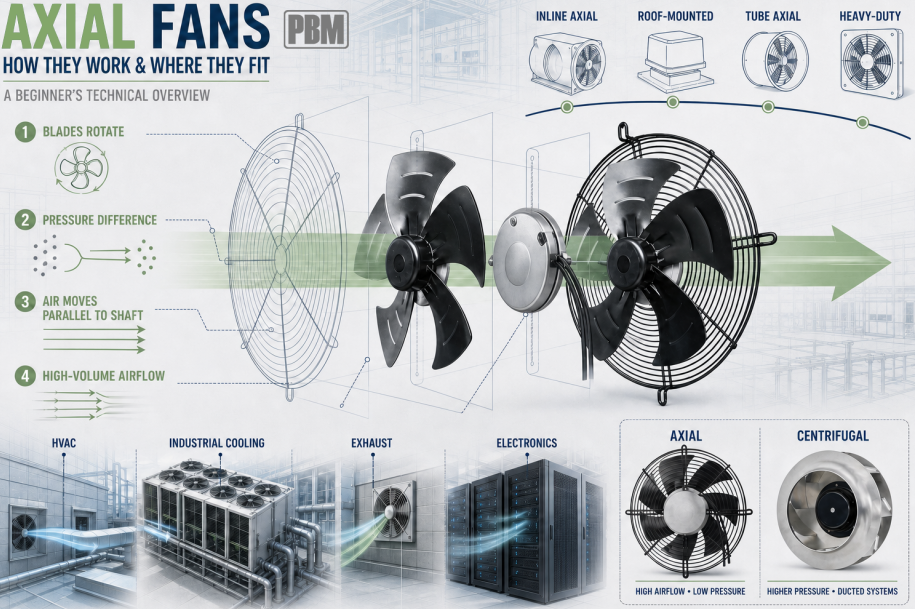
Axial fans are versatile and are used in many industries, including:
HVAC Systems: Axial fans are often used in residential and commercial air conditioning systems to circulate cool air. They are also used in ventilation systems to maintain airflow.
Industrial Cooling: In industrial settings, axial fans are used to cool machines, equipment, and entire production lines. They provide high airflow to keep temperatures within acceptable limits.
Automotive and HVAC: Axial fans are commonly found in automobile cooling systems, where they help circulate air through radiators to prevent overheating.
Exhaust Systems: In exhaust applications, such as kitchens, factories, and warehouses, axial fans are used to remove hot air, fumes, and odors.
Electronics Cooling: Axial fans are often employed in electronic cooling, particularly in computers and server rooms, where they keep temperatures in check to prevent overheating.
While both axial fans and centrifugal fans are used to move air, they differ significantly in design, airflow, and applications. Here’s a comparison to help you understand when each is best suited for your needs:
| Factor | Axial Fans | Centrifugal Fans |
|---|---|---|
| Airflow Direction | Parallel to the axis of rotation | Perpendicular to the axis of rotation |
| Air Pressure | Lower pressure, high airflow | Higher pressure, lower airflow |
| Design | Simpler, with blades mounted on a central hub | More complex, with curved blades or scrolls |
| Efficiency | More efficient for low-pressure applications | More efficient for high-pressure applications |
| Common Uses | Ventilation, cooling, exhaust in large areas | Industrial processes, HVAC systems needing high pressure |
| Noise Level | Relatively quieter due to simpler design | Can be noisier due to higher pressure design |
When you need high airflow but low pressure.
For ventilation in large spaces with minimal resistance.
Ideal for exhaust applications in buildings, factories, and HVAC systems.
For high pressure applications like pushing air through ducts.
When you need air to be moved longer distances or through tight spaces.
When dealing with heavy industrial processes requiring high airflow pressure.
In conclusion, axial fans are a key component in many ventilation, cooling, and exhaust systems. They are best suited for applications that require high airflow and low pressure, such as in HVAC systems, industrial cooling, and exhaust fans. Understanding how axial fans work, their different types, and where they are best used can help you choose the most effective and energy-efficient fan for your needs.
By comparing axial fans with centrifugal fans, it’s clear that each type of fan has its specific advantages depending on your application. Axial fans are great for air circulation and cooling in large, open spaces, whereas centrifugal fans excel in high-pressure, ducted applications. Choose the right fan based on your needs to maximize performance, efficiency, and comfort.
 If you have any interest in our products,please feel free to contact us & we are ready to serve you

By continuing to use the site you agree to our privacy policy Terms and Conditions.