FOCUS ON EC FAN ONLY
FOCUS ON EC FAN ONLY
Effective cold air circulation is essential for a wide range of applications—from cold storage warehouses and refrigerated transport to industrial cooling systems and commercial freezers. The right fan ensures consistent temperature distribution, prevents condensation and frost buildup, and optimizes energy consumption. But with so many options on the market, how do you select the best fan for your specific cold air circulation needs?
This guide breaks down the key factors to consider, helping you make an informed decision that balances performance, durability, and operating costs.
The first step in selecting a fan for cold air circulation is understanding your airflow needs. This is typically measured in CFM (Cubic Feet per Minute) or m³/h (Cubic Meters per Hour).
Questions to ask yourself:
·What is the volume of the space to be cooled?
·How quickly does the air need to circulate?
·Is the application for spot cooling or whole-room circulation?
General guidelines:
·Small enclosures or cabinets: 100–500 CFM
·Medium cold rooms or walk-in freezers: 500–2,000 CFM
·Large warehouses or industrial chillers: 2,000+ CFM
Overestimating airflow wastes energy; underestimating leads to temperature stratification—warm pockets at the ceiling and cold spots on the floor.
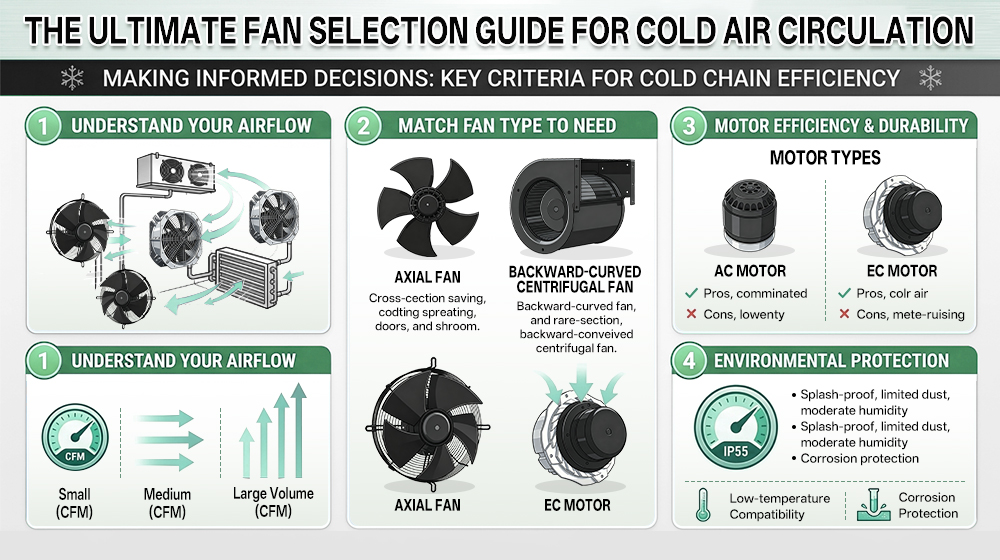
Not all fan types perform equally well in low-temperature environments. Here's how common fan types compare:
| Fan Type | Best Use Case | Cold Air Performance |
| Axial Fan | High-volume, low-pressure applications (e.g., evaporators, condensers) | Excellent airflow with low energy consumption |
| Centrifugal Fan (Backward Curved) | Medium-to-high pressure ducted systems | High efficiency, handles resistance from coils and filters |
| Centrifugal Fan (Forward Curved) | Compact systems requiring high pressure | Good but less efficient than backward curved |
| Blower (Single/Dual Inlet) | Spot cooling, equipment enclosures | Provides concentrated, high-velocity airflow |
| Cross-Flow/Tangential Fan | Narrow spaces, air curtains | Uniform airflow across a wide area |
For cold storage and refrigeration applications, axial fans and backward curved centrifugal fans are the most common choices. Axial fans excel at moving large volumes of air across evaporator coils, while backward curved fans offer better efficiency when ductwork or high static pressure is involved.
Static pressure is the resistance a fan must overcome to move air through a system. In cold air circulation, resistance comes from:
·Evaporator coils
·Ductwork and bends
·Filters
·Air curtains or grilles
·Long air distribution paths
How to evaluate:
·Low static pressure (< 200 Pa): Axial fans are usually sufficient
·Medium static pressure (200–600 Pa): Backward curved centrifugal fans or blowers
·High static pressure (> 600 Pa): Forward curved or dual-inlet blowers
Pro tip: Always check the fan performance curve, not just the maximum airflow rating. The curve shows how airflow decreases as static pressure increases, helping you match the fan to your system's actual operating point.
The motor is the heart of any fan. Choosing the right motor type directly impacts energy consumption, speed control, and long-term reliability in cold environments.
| Motor Type | Efficiency | Speed Control | Best For |
| AC Motor | Low–moderate (70–88%) | Limited, fixed speed | Budget-conscious, simple systems |
| DC Motor | Moderate (80–90%) | Good with additional controllers | Battery-powered or mobile applications |
| EC Motor | High (>90%) | Built-in, fully variable | Cold storage, HVAC, demanding applications |
Why EC motors excel in cold air circulation:
·Energy savings: EC motors are typically 20–50% more efficient than AC motors, translating to significant annual savings in refrigeration applications
·Variable speed control: Unlike AC motors that run at fixed speeds, EC motors adjust automatically to maintain consistent airflow even as system resistance changes (e.g., when coils frost over)
·Lower heat output: EC motors generate less heat themselves, reducing the cooling load on your refrigeration system
·Built-in protection: Many EC motors feature overcurrent, overvoltage, and thermal protection—critical in harsh cold environments
·Extended lifespan: Reduced mechanical stress and lower operating temperatures mean longer service life, especially important in 24/7 refrigeration applications
Cold air circulation fans operate in demanding conditions—low temperatures, high humidity, and frequent temperature cycling. Here's what to evaluate:
Operating Temperature Range
Ensure the fan is rated for your minimum temperature. Standard fans may fail below -10°C due to bearing grease thickening or plastic components becoming brittle. For freezer applications down to -40°C, specialized cold-weather fans are required.
IP Protection Rating
The IP (Ingress Protection) rating indicates resistance to dust and moisture:
| IP Rating | Protection Level | Suitable Environment |
| IP44 | Splash-proof, limited dust | Dry cold rooms, moderate humidity |
| IP54 | Dust-protected, water splash | Humid cold storage, occasional washdown |
| IP55 | Dust-protected, low-pressure water jets | Frost-heavy environments, frequent defrost cycles |
| IP66 | Dust-tight, high-pressure water jets | Extreme environments, high-pressure washdown |
Why IP55 and IP66 matter in cold air circulation: Frequent defrost cycles create condensation and moisture, which can damage standard fans. Waterproof fans with BMC (Bulk Molding Compound) stator overmolding resist moisture ingress and corrosion, significantly extending service life in cold, wet conditions.
Material Considerations
·Housings: Galvanized steel or stainless steel resist corrosion
·Impellers: Glass-fiber-reinforced plastic remains stable at low temperatures; metal blades may be necessary for heavy-duty applications
·Bearings: Sealed ball bearings are preferred over sleeve bearings in cold environments
·Seals: Rubber gaskets prevent moisture infiltration around shafts
Modern cold air circulation systems often require intelligent control for optimal performance and energy efficiency.
Control options to consider:
| Control Type | Benefits | Typical Use |
| On/Off | Simple, low-cost | Basic systems, backup fans |
| 0-10V / PWM signal | Variable speed control | Energy-optimized systems |
| RS485 / Modbus | Remote monitoring and control | Automated warehouses, integrated BMS |
| IoT-ready | Cloud monitoring, alerts, predictive maintenance | Large-scale operations, critical applications |
In cold storage: EC motors with built-in RS485 communication allow system controllers to adjust fan speed based on real-time temperature and defrost status—reducing energy waste and preventing unnecessary cooling.
Fan size and mounting affect both performance and space utilization.
Key sizing factors:
·Impeller diameter: Larger diameter typically means higher airflow at lower speeds (quieter operation)
·Mounting orientation: Axial fans mount vertically or horizontally; centrifugal fans often require specific orientation
·Space constraints: Compact designs (e.g., single inlet blowers) fit into tight enclosures
·Installation depth: Some applications require slim-profile fans (e.g., cross-flow fans for air curtains)
Installation considerations:
·Ensure clear inlet and outlet paths for unrestricted airflow
·Account for vibration isolation if the fan is mounted on vibration-sensitive surfaces
·Plan for maintenance access—fans in cold environments may need periodic cleaning to prevent ice buildup
Cold air circulation fans often run 24/7, making noise and vibration important factors—especially in retail cold rooms, supermarket freezers, and food processing areas.
What to look for:
·Noise level (dBA): Compare at your required operating point, not just at maximum speed
·Vibration isolation: Rubber mounts or flexible connectors reduce noise transmission
·Balanced impellers: Factory-balanced impellers reduce vibration and prolong motor life
·Smooth airflow design: Aerodynamically optimized housings and blades reduce turbulence noise
Typical noise levels:
·Small fans (< 200mm): 50–65 dBA
·Medium fans (200–400mm): 65–75 dBA
·Large fans (> 400mm): 70–80+ dBA
The lowest-priced fan is rarely the best value. Calculate Total Cost of Ownership over the fan's expected lifespan:
TCO formula: Initial Purchase Price + (Annual Energy Cost × Lifespan in Years) + (Maintenance Cost per Year × Lifespan in Years)
Example comparison for a refrigeration evaporator fan:
| Factor | Standard AC Fan | Premium EC Fan |
| Purchase price | $200 | $350 |
| Annual energy cost | $300 | $150 |
| Expected lifespan | 5 years | 8 years |
| Maintenance/year | $50 | $20 |
| 5-year TCO | $2,050 | $1,610 |
| 8-year TCO | $3,300 | $1,950 |
The premium EC fan costs more upfront but delivers significant savings over its lifetime—and better performance throughout.
For commercial and industrial cold air circulation, verify the fan meets:
·ISO 9001 – Quality management
·CE marking – European safety standards
·UL/CSA – North American safety
·RoHS – Restriction of hazardous substances
·ISO 5801 – Fan airflow performance
·ErP Directive (EU 327/2011) – Eco-design requirements for fans driven by motors with electric input power between 125W and 500kW
For refrigeration-specific applications: Check compliance with relevant refrigeration system standards (e.g., EN 378 for refrigerating systems, PED for pressure equipment).
Summary Checklist: Choosing a Fan for Cold Air Circulation
| Selection Factor | Key Considerations |
| Airflow (CFM/m³/h) | Match to space volume and required air changes |
| Fan type | Axial for high volume; centrifugal for high pressure; blowers for focused airflow |
| Static pressure (Pa) | Account for coils, ducting, and filters |
| Motor type | EC motors offer best efficiency and variable speed control |
| Operating temperature | Verify rating for your min. temperature (-10°C, -25°C, -40°C) |
| IP rating | IP54/IP55 for humid cold storage; IP66 for washdown environments |
| Control options | 0-10V, PWM, RS485, or IoT-ready for system integration |
| Material suitability | Corrosion-resistant housing, low-temp impellers, sealed bearings |
| Noise (dBA) | Match to environment (retail vs. warehouse vs. machine room) |
| TCO | Compare energy costs, maintenance, and lifespan—not just purchase price |
| Certifications | ISO 9001, CE, UL, RoHS, ErP compliance |
Choosing the best fan for cold air circulation requires a systematic approach. Start by defining your airflow and pressure requirements, then evaluate motor types—with EC motors offering the best combination of efficiency, controllability, and reliability in cold environments.
Don't overlook environmental factors: IP55-rated construction, low-temperature materials, and corrosion-resistant components are essential for dependable long-term performance. And remember: the cheapest option upfront is rarely the most cost-effective over time—especially in 24/7 refrigeration applications where energy costs accumulate quickly.
Whether you're outfitting a walk-in freezer, designing an evaporator unit, or optimizing a cold chain logistics facility, the right fan will deliver consistent temperatures, lower energy bills, and fewer service interruptions.
PBM Motor and Fan has over 15 years of experience in DC/EC motor and fan technologies, with a comprehensive product range including IP55 waterproof fans, backward and forward curved centrifugal fans, axial fans, blowers, and duct fans—all suited for cold air circulation and refrigeration applications.
 If you have any interest in our products,please feel free to contact us & we are ready to serve you

By continuing to use the site you agree to our privacy policy Terms and Conditions.