FOCUS ON EC FAN ONLY
FOCUS ON EC FAN ONLY
An axial fan can move a large volume of air through a short, direct path. That makes it a strong candidate for condenser cooling, equipment ventilation, wall exhaust, air circulation, and other industrial duties with modest system resistance. The same fan can disappoint when a filter loads with dust, a coil has a higher-than-expected pressure drop, or an installer places an elbow against the inlet.
For an equipment manufacturer or plant engineer, the useful question is not simply where axial fans are used. It is whether the required operating point sits inside the fan's stable range after every grille, coil, guard, louver, duct section, and environmental condition has been counted. This guide explains the roles and benefits of industrial axial fans, the limits behind those benefits, and the information a supplier needs to make a defensible selection.
An axial fan draws air in and discharges it in a direction parallel to the motor shaft. Its blades generate aerodynamic lift, creating a pressure difference that moves air through the impeller. The straight flow path and compact construction suit high-airflow duties where the system does not impose a large pressure loss.
“Low pressure” does not mean “no pressure.” A coil, grille, wall ring, protective guard, filter, heat exchanger, or short duct all add resistance. The selected fan must produce the required airflow at the total static pressure of the installed system. A free-air value measured near zero pressure cannot be used as the expected airflow after the fan has been built into equipment.
The U.S. Department of Energy's fan-system sourcebook places axial fans in clean-air, low-pressure, high-volume applications and warns that oversizing can create inefficient operation, excess noise, vibration, and poor reliability. Those points are directly relevant to OEM selection: diameter and maximum airflow are only the beginning of the specification.
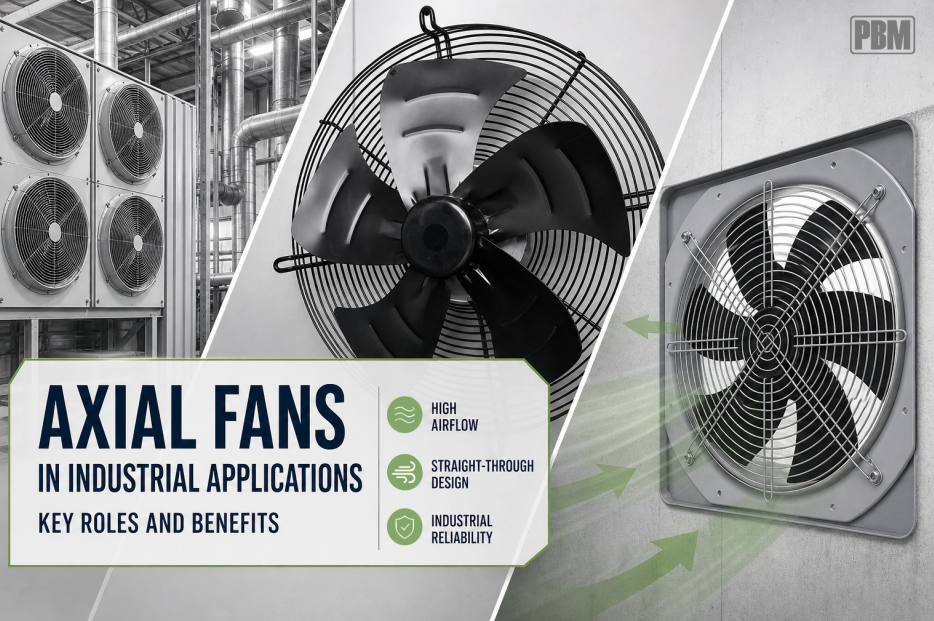
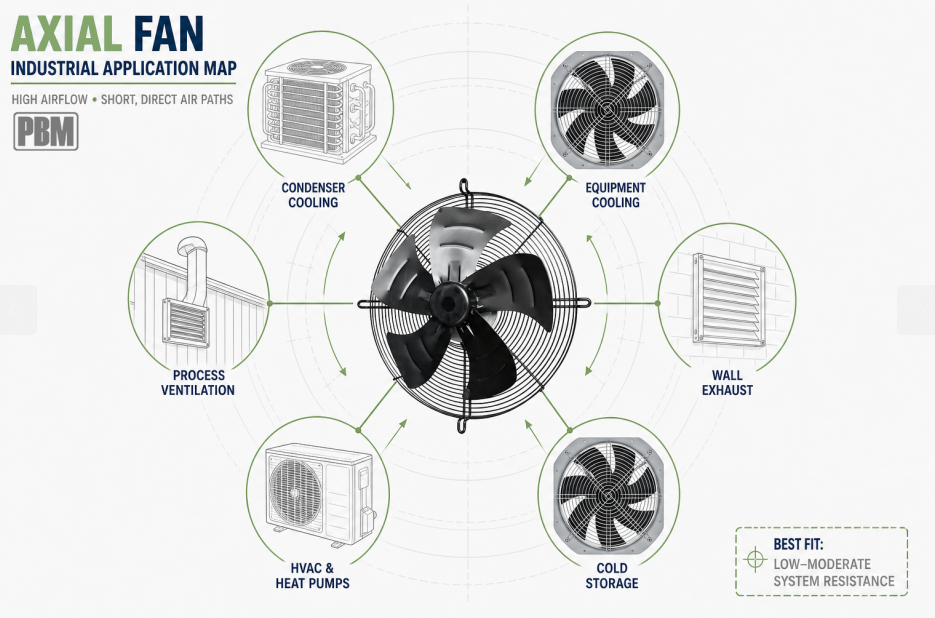
Industry labels are a weak basis for selection. Two machines in the same factory can present completely different airflow paths. It is more useful to define the task the fan performs and the resistance it must overcome.
| Industrial task | What the fan must do | Main resistance or operating risk | Selection focus |
|---|---|---|---|
| Condenser or heat-exchanger cooling | Pull or push air through a coil while rejecting heat | Coil pressure drop, blocked fins, recirculation, changing ambient temperature | Airflow at the coil's pressure drop, motor temperature margin, speed-control range |
| Machine and control-enclosure cooling | Remove heat from motors, drives, power electronics, or process equipment | Restricted openings, filters, local hot spots, dust ingress | Required heat rejection, inlet filtration, IP protection, alarm or speed signal |
| Factory fresh-air supply or wall exhaust | Exchange indoor and outdoor air across a wall or short opening | Louvers, backdraft shutters, wind pressure, poor inlet clearance | Air-change target, opening size, weather protection, discharge location |
| Cold-storage air circulation | Move air across an evaporator and distribute cooled air through the space | Coil frost, low-temperature materials, uneven distribution, moisture | Airflow through the coil, low-temperature suitability, defrost conditions, corrosion resistance |
| HVAC and heat-pump equipment | Move outdoor or process air through a condenser, evaporator, or short air path | Part-load operation, coil fouling, acoustic limits, seasonal variation | Duty range rather than one point, EC speed control, sound data, installation clearance |
| Process-area ventilation | Dilute heat or light airborne contaminants and bring in replacement air | Unverified contaminant concentration, long discharge path, hazardous or corrosive gas | Ventilation calculation, airstream compatibility, motor location, applicable safety requirements |
This table also shows a boundary that procurement teams sometimes miss. An axial fan may circulate clean air in a workshop, but that does not make a standard model suitable for abrasive dust, combustible atmospheres, corrosive vapor, or high-temperature process gas. Those duties require a written environmental specification and, where applicable, correctly certified equipment.
Axial fans can move large air volumes without turning the flow through a scroll housing. In a wall opening, condenser, cooler, or short air path, that arrangement can deliver the required airflow in less installation depth than many centrifugal designs. The benefit depends on the operating point. Once system resistance rises, an apparently generous free-air rating can fall short.
Air enters and leaves on the same axis, which can simplify an OEM enclosure or heat-exchanger layout. The motor, impeller, guard, wall ring, and mounting structure can form a compact module. Designers still need adequate inlet and outlet clearance. A nearby panel, sharp transition, or elbow can create swirl and uneven velocity across the fan.
Many industrial systems do not need full airflow all day. An EC axial fan with an appropriate control input can reduce speed during low-load periods and increase it as temperature or process demand rises. This can reduce throttling losses and avoid repeated on-off cycling. The controller, sensor logic, minimum stable speed, communication method, and electromagnetic-compatibility requirements must be agreed for the selected model rather than assumed from the term “EC fan.”
A direct-drive external-rotor arrangement does not need belts, pulleys, or a separate shaft coupling. That removes belt tension and alignment tasks. It does not eliminate maintenance: blade deposits, loose mounts, blocked guards, bearing condition, wiring, vibration, and abnormal sound still require inspection.
Axial platforms can cover compact electronics cooling through large condenser and ventilation assemblies. This gives OEM buyers room to standardize controls or mounting concepts across several capacities. Standardization should follow performance verification; a mechanically similar family can have different power, speed, pressure, and acoustic behavior at each size.
Axial is not the default for every industrial ventilation project. If the air path has long ducts, several bends, dense filters, high-resistance heat exchangers, or a process that needs stable pressure, a centrifugal fan deserves early consideration. PBM's guide to the differences between a centrifugal blower and an axial fan provides a broader comparison.
| Decision condition | Axial fan is the stronger starting point | Centrifugal fan is the stronger starting point |
|---|---|---|
| Airflow path | Open or short and straight | Long, branched, or heavily ducted |
| System resistance | Low to moderate and well defined | Moderate to high, or expected to rise as filters load |
| Installation geometry | Straight-through airflow and shallow depth are valuable | A 90-degree change in airflow direction fits the equipment layout |
| Air condition | Clean air within the model's rated environment | The process calls for a construction designed around a more demanding airstream |
| Primary design concern | Moving a large volume efficiently | Maintaining flow against pressure loss |
A mixed-flow or vane-axial design can occupy part of the space between these choices, but its name does not replace a fan-curve review. Compare the required duty point and allowable operating region for the actual installation.
State the required airflow in m³/h or CFM and the total static pressure in Pa or in. w.g. at the same operating condition. Include air temperature, altitude, and gas density if they differ materially from standard test conditions. If the machine has several operating modes, provide a duty range rather than one nominal point.
List coils, filters, guards, louvers, dampers, sound attenuators, ducts, bends, and outlet restrictions. Use supplier pressure-drop data at the intended airflow. Add the effects of expected filter loading or coil fouling when they are part of normal operation. Do not add a large arbitrary safety margin and then solve the resulting excess flow with throttling.
The system curve and fan curve intersect at the operating point. Check that this point remains acceptable across the expected speed and resistance range. PBM's article on understanding an axial fan performance curve explains the airflow, pressure, power, efficiency, and sound relationships buyers should review.
Laboratory ratings are measured with controlled airflow. Field installations rarely reproduce those conditions. AMCA describes “system effect” as performance loss caused by adverse flow, including turbulence or swirl near the fan. An elbow, obstruction, abrupt transition, or uneven inlet can lower delivered airflow and increase sound and vibration. Provide straight, unobstructed flow where possible, and send the supplier a drawing when the fan sits close to coils, walls, or transitions.
Confirm supply voltage, phase, frequency, permitted voltage range, input power, connector or terminal arrangement, grounding, speed-control input, feedback signal, communication protocol, and fault behavior. For a DC design, state the available bus voltage and control electronics. For an EC-AC design, confirm whether the selected model accepts 0–10 V, PWM, or another control method.
State minimum and maximum ambient temperatures, humidity or condensation, dust, water exposure, salt, cleaning chemicals, vibration, orientation, and indoor or outdoor placement. An IP rating addresses defined ingress conditions; it does not by itself prove corrosion resistance, chemical compatibility, explosion protection, or suitability for direct weather exposure. PBM offers a separate IP55 axial fan range for applications that need greater dust and water-ingress protection, subject to model-level confirmation.
Ask for sound data at or near the proposed operating point, not only a minimum catalog figure. Define the measurement distance and sound metric required by the project. Provide fan diameter, maximum installation depth, mounting-hole pattern, guard requirement, airflow direction, cable exit, connector space, and allowable mass. Identify any resonance or vibration limits in the host equipment.
For an OEM project, the selection should end with drawings, a performance curve, electrical data, environmental limits, and a sample test in the customer's assembly. Verify airflow or thermal performance with production-representative coils, filters, guards, and panels installed. Record the control setting used during the test so the result can be reproduced.
PBM supplies EC and DC axial fan options for ventilation, heating, refrigeration, and equipment cooling. The published category data for the larger axial range lists impeller diameters from 200 to 630 mm and maximum airflow up to 14,500 m³/h. Model-level data should always control the final selection.
| Published PBM model | Electrical input | Rated input power | Published airflow | Published air pressure |
|---|---|---|---|---|
| PA3N200B2EH | 230 VAC | 70 W | 1,160 m³/h | 320 Pa |
| PG3N400B2EH | 230 VAC | 400 W | 5,200 m³/h | 250 Pa |
| PG3N630B4EM | 380 VAC | 800 W | 14,500 m³/h | 240 Pa |
These figures show why a supplier needs the duty point. The highest-airflow model is not the highest-pressure choice, and two fans with similar diameters can have different speeds and electrical requirements. Before publication or quotation, confirm the latest datasheet for the exact model because PBM notes that product specifications may be updated.
If a fan already has unstable airflow, excess noise, vibration, or thermal alarms, review PBM's axial fan troubleshooting guide before replacing it with a larger unit. The problem may be blockage, installation geometry, electrical control, or an operating point outside the intended range.
They are used to move high air volumes through low- to moderate-resistance paths. Common duties include condenser cooling, equipment ventilation, wall exhaust, cold-storage circulation, air handling, and process-area air exchange.
A standard propeller or panel axial fan is rarely the first choice for a long, restrictive duct system. A tube-axial or vane-axial design may handle more pressure, but the duty point still has to be checked. A centrifugal fan may be the safer starting point when pressure loss is high.
Start with the heat load, allowable temperature rise, air properties, and airflow path. Then add the pressure loss of the coil, filter, grille, and enclosure. For occupied-space ventilation, use the applicable ventilation code or process requirement rather than a generic air-change figure.
EC motors can provide efficient speed control and good part-load operation, but system efficiency depends on the full operating point, impeller, motor, controller, and installation. Compare input power at the required airflow and pressure instead of comparing motor labels alone.
Compare airflow and static pressure at the same duty point, input power, speed, sound data, supply and control requirements, environmental rating, dimensions, mounting, expected operating range, and the test standard behind the published data.
IP55 addresses limited dust ingress and low-pressure water jets under defined test conditions. Outdoor suitability also depends on drainage, connector sealing, direct rain or sun exposure, corrosion, temperature, and mounting orientation. Confirm those conditions with the supplier for the exact model.
The catalog value may be a free-air maximum, while the installed system adds resistance. Other causes include blocked coils or filters, recirculation, insufficient inlet clearance, an elbow near the fan, incorrect speed control, wrong rotation, or lower-than-expected supply voltage.
Do not add capacity without quantifying the future duty. Oversizing can place the fan in an inefficient region and create excess sound, flow, or vibration. If future demand is real, define both duty points and select a controllable fan that operates acceptably at each one.
Send the application, required airflow and static pressure, air temperature, voltage, control method, environmental conditions, fan diameter or space limit, mounting drawing, noise target, quantity, sample schedule, and production timeline. A photo or airflow-path drawing helps identify restrictions that a list of specifications may miss.
The main advantage of an industrial axial fan is straightforward: it can move a large volume of air through a compact, straight path. That advantage is valuable only when the installed resistance, environmental conditions, controls, and mechanical layout match the fan's operating range.
For a model recommendation, send PBM your required airflow, static pressure, installation drawing, voltage, control signal, ambient conditions, noise limit, quantity, and project schedule through the contact page. The engineering review can then compare the required duty point with the relevant EC or DC axial fan curves and identify any information that needs prototype validation.
 If you have any interest in our products,please feel free to contact us & we are ready to serve you

By continuing to use the site you agree to our privacy policy Terms and Conditions.