FOCUS ON EC FAN ONLY
FOCUS ON EC FAN ONLY
When designing an air movement system, one of the most common questions is whether to choose a centrifugal fan or an inline duct fan. The answer depends on the application, airflow requirements, installation space, and pressure conditions.
Choosing the wrong fan can lead to poor airflow, excessive noise, higher energy consumption, and unnecessary maintenance. Choosing the right one helps the system run reliably for years.
This guide compares both fan types from a practical engineering perspective, focusing on performance, installation, and the situations where each option works best.
To get the most out of your system, you need to look at how these fans handle flow and pressure. The operating principle directly affects performance, installation requirements, and the situations where each design works best.
A centrifugal fan pulls air into the center of a spinning impeller and flings it outward at a 90-degree angle. The air either goes through a scroll housing or exits as a freewheel configuration. Either way, the kinetic energy gets converted into static pressure, which is what you need when there’s resistance in the system.
PBM makes two types. If your system has long duct runs, filters, heat exchangers, or tight bends — anything that creates back pressure — a backward curved centrifugal fan is usually the right call.
An inline duct fan mounts straight inside round ductwork. Air goes in one end and out the other, same axis. That makes it dead simple to drop into an existing duct run.
One important detail is often overlooked: PBM’s inline fans are centrifugal-based, not axial. They use a backward or forward curved impeller inside a tubular housing, so they deliver way more static pressure than a typical tube axial inline fan. Think of them as a hybrid — easier to install than a scroll-housing centrifugal, but with pressure numbers that come close (up to 1,000 Pa).
In the HVAC world, “inline fan” can mean two different things — axial inline (low pressure, high airflow) or centrifugal inline (moderate to high pressure). PBM’s duct fans are the second kind, and that distinction matters when you’re sizing a system.
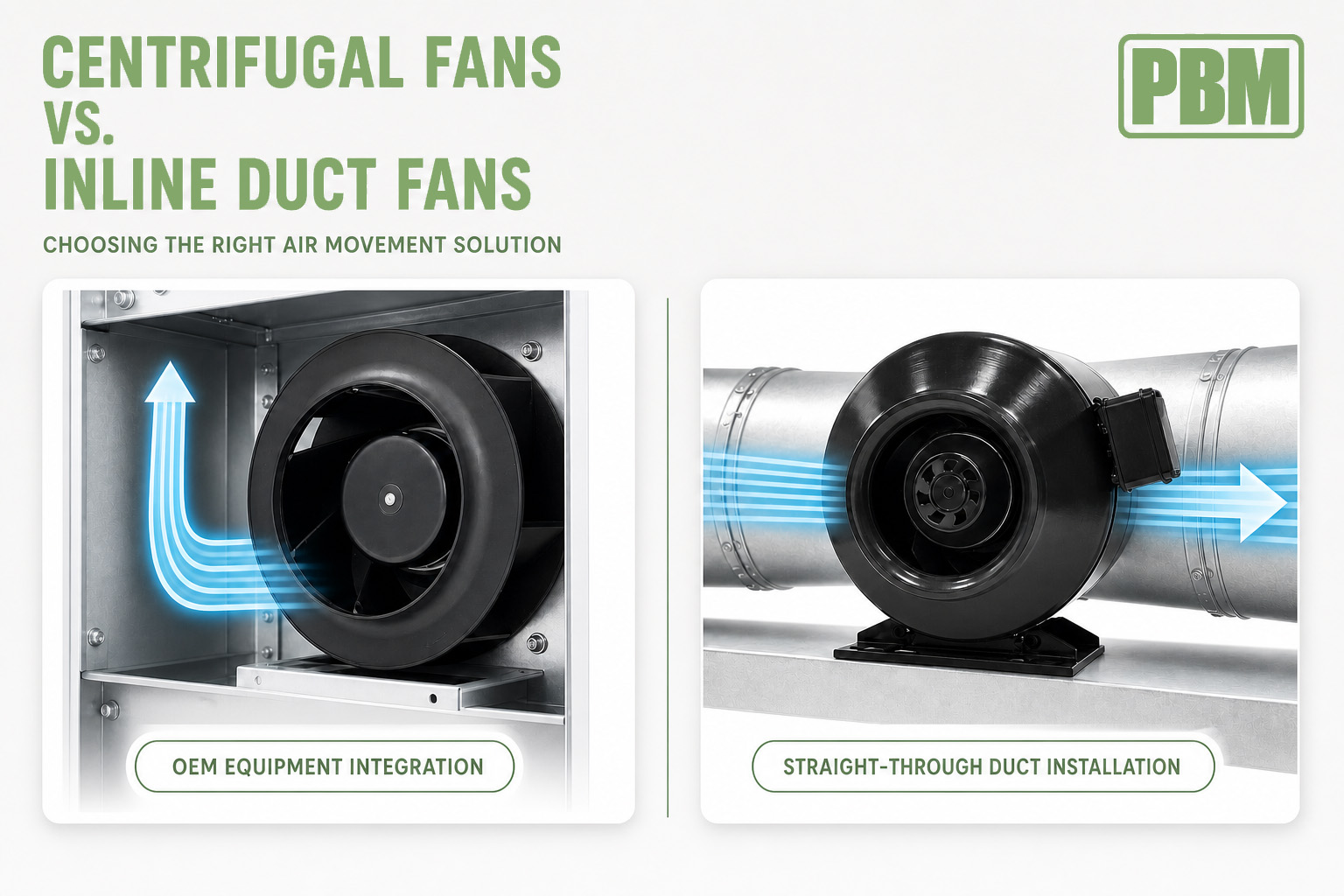
Here’s how two real PBM models stack up against each other.
| Parameter | Backward Curved Centrifugal Fan (PB3N133B2EH) | Inline Duct Fan (PQ3N200B2E-TZ0) |
|---|---|---|
| Impeller / Duct Diameter | 133 mm | 200 mm (duct diameter) |
| Max Airflow | 460 m³/h (271 CFM) | 1,180 m³/h (694 CFM) |
| Max Static Pressure | 475 Pa (1.90 inH₂O) | 1,000 Pa (4.00 inH₂O) |
| Input Power | 48 W | 170 W |
| Noise Level | 75 dB(A) | 71 dB(A) |
| Speed | 4,480 RPM | 2,700 RPM |
| IP Rating | IP44 | IP55 |
| Operating Temp | -25°C to 60°C | -25°C to 60°C |
| Design Life | 50,000 hours | 50,000 hours |
Airflow and pressure are just the starting points. To pick the right fan, you also need to map out your physical layout, how you want the air to flow, and how easy it’ll be to service down the road.
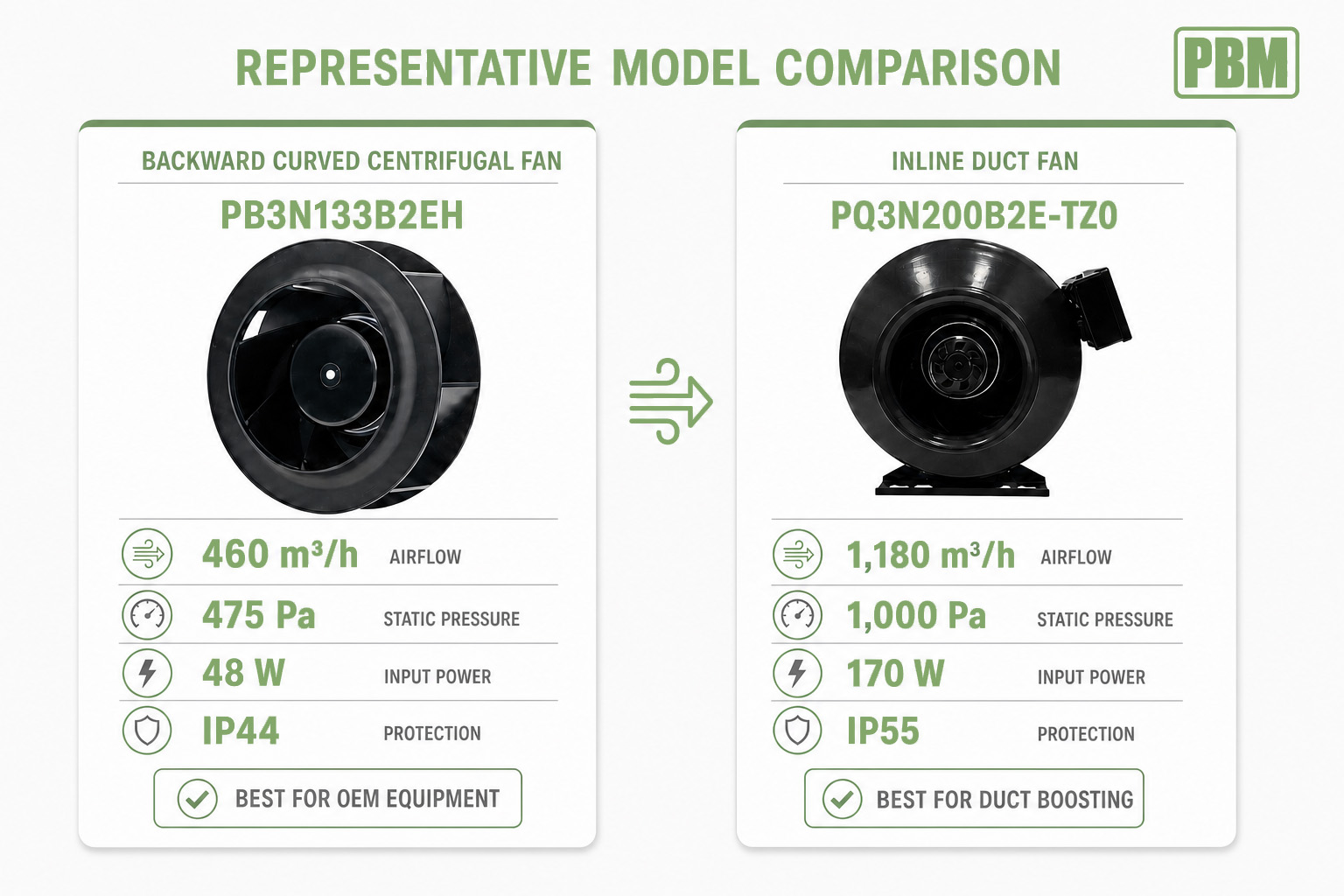
Centrifugal Fans
Inline Duct Fans
This is the biggest difference between the two.
1. Equipment Integration (OEM)
Need to cool a server rack, CT scanner, power supply cabinet, or air handler? A compact centrifugal fan fits inside the enclosure and pushes air through whatever’s in the way — filters, heat sinks, tight channels.
2. High-Pressure Industrial Ventilation
Factories, paint booths, dust collectors — these systems have high resistance. Backward curved centrifugal fans handle it, with static pressure ratings up to 1,700 Pa.
3. Tight Spaces
Telecom cabinets, medical devices, electronics enclosures — when every cubic inch counts, a freewheel centrifugal fan delivers targeted cooling without hogging space.
1. Duct Boosting and HVAC Balancing
Got a second-floor office that’s always baking, or a finished basement that feels stuffy? Nine times out of ten, you’re dealing with low static pressure in those long branch runs. Instead of overhauling your entire HVAC system, you can splice an inline fan directly into that struggling duct run to give the airflow a serious kick. A 200mm model pushing 1,180 m³/h can fix the imbalance without touching the main HVAC unit.
Related: What Are Inline Duct Fans Used For? 5 Common Applications
2. Long-Duct Exhaust Systems
Underground parking garages, commercial kitchens, paint booths — when the exhaust point is far from the source, inline fans hold pressure across the whole run. PBM’s PQ3N200B2E-TZ0 can serve eight parking garage exhaust outlets at once with its 1,000 Pa static pressure.
3. Noise-Sensitive Environments
Home theaters, libraries, hotel bathrooms, recording studios — mount the fan in the attic or a mechanical room, and the ductwork acts as a natural silencer. The noisy part stays away from where people are.
4. Retrofits
Existing ducts underperforming? Drop in an inline fan — no structural changes, no new housing, no re-routing.
Related: What Are Centrifugal Fans Used For?
Once the application requirements are clear, the selection process becomes much simpler. The following steps provide a practical way to evaluate the available options.
Four steps to get to the right choice:
Match your priority to the right type:
The motor choice drives long-term operating costs more than anything else.
Usually not. Inline duct fans are designed for duct systems, while OEM equipment such as server racks, medical devices, and power supply enclosures often require compact fans with flexible mounting and targeted airflow. In these cases, a freewheel centrifugal fan is usually the better option.
Inline duct fans often provide lower perceived noise because they can be installed remotely and use the duct system to reduce sound transmission. However, a properly selected centrifugal fan can also achieve quiet operation depending on speed, load, and system design.
When both use PBM EC motor technology, the efficiency difference is minimal. Both can achieve up to 91% motor efficiency and support variable speed control. Actual energy savings depend more on system design and operating control.
Forward curved fans are suitable for compact, lower-pressure applications up to 666 Pa. Backward curved fans are better for higher-pressure systems, offering pressure capability up to 1,700 Pa and improved efficiency under heavier loads. See the detailed comparison: Difference Between Forward Curved and Backward Curved Fans.
Every air movement system is unique. PBM’s engineering team offers free technical consultations to help you match the right fan to your specific application requirements, whether it’s a centrifugal fan for your next equipment design or an inline duct fan for a ventilation retrofit.
Send us your system parameters (airflow, static pressure, space constraints, and power supply), and our engineers will recommend the optimal solution within 24 hours.
 If you have any interest in our products,please feel free to contact us & we are ready to serve you

By continuing to use the site you agree to our privacy policy Terms and Conditions.