FOCUS ON EC FAN ONLY
FOCUS ON EC FAN ONLY
You may have wondered, "What are inline duct fans used for?" if you have ever entered a stuffy room or observed that the temperature in your grow tent was rising too high. The short answer: they move air through ducts when natural airflow or standard fans aren’t enough.
Inline duct fans are installed inside round or rectangular ductwork. They overcome static pressure caused by long duct runs, bends, filters, or grilles. In this guide, we break down 5 common applications in detail—including real‑world scenarios, sizing advice, and the specific features that matter most.
Let’s dive in.
The Problem
A second-floor bedroom, a completed basement, or an expansion are examples of distant areas that always seem too hot in the summer and too cold in the winter, even though the HVAC system in many houses and small workplaces provides sufficient cool or warm air to rooms close to the air handler. Insufficient static pressure results from the blower's inability to force enough air through ducts that are lengthy, small, or poorly constructed.
How an Inline Duct Fan Solves It
Installing a duct booster fan or HVAC inline fan directly inside the problem branch duct acts like a “helper” fan. It senses or synchronizes with the main system and spins up to push more conditioned air into that specific zone.
Extended Scenarios
Multi‑story homes: A 6‑inch inline duct fan installed in the vertical run to a second‑floor bedroom can reduce summer temperature differences by 5–8°F.
Finished basements: Basement ducts are often undersized. An inline duct fan with speed controller lets you manually increase airflow when using the basement as a home theater or gym.
Additions and sunrooms: During the heat, these areas require additional cooling. When the sunroom temperature rises over 78°F, a temperature controller and a high CFM inline fan activate automatically.
Sizing & Selection Tips
| Duct Diameter | Recommended Fan Size | Typical CFM Range |
| 4-inch | 4-inch inline duct fan | 80 – 150 CFM |
| 6-inch | 6-inch inline duct fan | 180 – 300 CFM |
| 8-inch | 8-inch inline duct fan | 400 – 700 CFM |
| 10-inch | 10-inch inline duct fan | 700 – 1100 CFM |
Expert advice: To stop air from leaking backward when the booster is off, use an inline fan with a backdraft damper for HVAC boosting. A speed controller also aids in striking a balance between performance and loudness.
The Problem
When the duct run is longer than fifteen feet or contains several elbows, standard ceiling exhaust fans frequently have trouble. Slow moisture removal, persistent smells, and, finally, mold or mildew are the outcomes. Heat accumulation and musty air that never completely exchanges with the outside are problems in basements and attics.
How an Inline Duct Fan Solves It
By placing an inline exhaust fan or inline bathroom fan along the duct (usually in the attic or between joists), you get much higher static pressure – typically 2 to 3 times that of a typical ceiling fan. This pushes air through longer runs, even with bends and silencers.
Extended Scenarios
Bathroom with toilet room: You can use one inline fan to serve two exhaust grilles. This is a thing because it reduces noise directly above your head. To keep the bathroom quiet, you should use a low-noise inline duct fan that's less than 1.0 sone.
Kitchen range hood supplement: If the fan on your over-the-range microwave is not very strong, you can add an inline duct fan to the 6-inch duct. This will help to remove air when you are stir-frying or cooking smoky dishes. The inline duct fan can actually double the extraction rate.
Ventilation: In the summer the air in the attic can get very hot. You can use an inline duct fan to remove this air. The fan can be mounted to a roof or gable vent. This will help to lower the temperature in the attic from 140°F to 110°F.
Crawlspace/basement drying: You can use an inline duct fan with a humidistat to keep the crawlspace or basement dry. The fan will only run when the humidity level gets too high, which is over 60%. This will help to prevent termites or rot.
Things to Think About
Humidity sensor or controller: An inline duct fan with a temperature humidity controller is a good thing. It automates the process so you do not have to think about it.
Humidity sensor or controller: The procedure is automated using an inline duct fan equipped with a temperature humidity controller.
Low noise: Look for silent inline duct fan ratings under 30 dBA for bathrooms adjacent to bedrooms.
Corrosion resistance: Select an EC motor model that can withstand mild grease in kitchens.
The Problem
Heat from grow lights (particularly HPS or high-power LED), excessive humidity from transpiration, and strong scents that must be filtered before draining outside provide three simultaneous problems for indoor producers. A standard oscillating fan does nothing for heat removal; a cheap axial fan lacks the static pressure needed to push through a carbon filter and long ducting.
How an Inline Duct Fan Solves It
The inline duct fan for grow tent is the industry standard. A properly sized inline fan creates negative pressure inside the tent (sides suck inward), pulling fresh air through the bottom vents and exhausting hot, humid, odorous air out the top through a carbon filter.
Extended Scenarios
Small tent (2′ x 2′ x 4′): A 4 inch inline duct fan with a small carbon filter is enough. But most growers jump to a speed‑controlled 6 inch for future expansion.
Medium tent (4′ x 4′ x 6′): The classic 6 inch inline duct fan moving 300‑400 CFM with a mixed flow inline fan design gives the best balance of airflow and noise.
An 8-inch or 10-inch inline duct fan with a high static pressure inline fan rating (≥1.0 inch w.g.) is required in a large grow room (several tents or an 8-by-8-inch space), particularly if the carbon filter is large.
Root rot in hydroponic systems (DWC/NFT) is accelerated by high humidity. During blooming, RH is maintained at 50–60% using a grow tent exhaust fan that cycles on and off with a humidistat
Matching Fan to Carbon Filter
| Tent Size | Fan Size | Carbon Filter Spec | Static Pressure Need |
| 2×2 | 4-inch | 4″ x 12″, 200 CFM | low (0.4 in w.g.) |
| 4×4 | 6-inch | 6″ x 16″, 400 CFM | medium (0.8 in w.g.) |
| 5×5 | 8 inch | 8″ x 20″, 750 CFM | high (1.2 in w.g.) |
Pro tip: Always oversize your inline fan slightly and use a speed controller. An inline duct fan with speed controller allows you to turn down airflow for quieter operation during dark cycles.
Odor Control
Pair your fan with an inline duct fan with carbon filter. For extreme odor (skunk strains, commercial grows), consider adding an inline duct fan silencer after the fan to reduce whoosh noise.
The Problem
Airborne contaminants from workshops, warehouses, commercial kitchens, and industrial facilities include smoke, wood dust, welding fumes, chemical vapors, and frying oil. Standard household fans break readily in these situations because they lack sufficient CFM, static pressure, and endurance.
How an Inline Duct Fan Solves It
Heavy gauge steel, sealed motors, and frequently spark-resistant or explosion-proof construction are used in the building of industrial inline duct fans. They transport polluted air via lengthy ducts, cyclones, or baghouses by delivering high CFM (1,000–10,000+) and high static pressure (1.5–4.0 inch w.g.).
Extended Scenarios
Woodworking shop dust collection: An inline fan for dust collection system placed before the cyclone separator helps capture fine dust before it reaches the filter. Use a mixed flow inline fan to maintain pressure even as filters load.
Commercial kitchen exhaust: A commercial kitchen exhaust inline fan must handle grease‑laden air. UL 762 listed fans with washable blades are required. Pair with a backdraft damper for inline fan to prevent cold air backflow when off.
Paint booth/welding fume extraction: An inline fan with spark-resistant aluminum wheels and an explosion-proof motor (Class I, Div 1) is required for smoke extraction.
Warehouse heat removal: Without the need for air conditioning, roof-mounted industrial inline duct fan high CFM versions improve worker comfort by drawing hot air trapped at the ceiling down or out.
Taking Energy Efficiency into Account
An EC motor inline duct fan reduces power consumption by 50–70% as compared to AC equivalents for buildings that operate fans continuously. EC motors also offer 0‑10V or PWM control for demand‑based ventilation (e.g., speed increases only when a dust sensor detects high particulate matter).
Durability Features
Sealed bearings for continuous duty
Corrosion‑resistant coating for chemical labs or saltwater environments
Thermal overload protection to prevent motor burnouts
In compact areas, modern gadgets produce a lot of heat. Temperatures exceeding 100°F can rapidly rise in a network rack, AV closet, or 3D printer enclosure, resulting in component throttling, reduced lifetime, or even thermal shutdown.
How an Inline Duct Fan Solves It
A 4-inch or 6-inch duct that draws hot air from the top of the enclosure and discharges it into a return plenum, attic, or outdoors can accommodate a small inline duct fan for server room cooling or AV closet cooling. The room itself may be made quiet by placing the inline fan remotely, such as in an attic or crawlspace.
Extended Situations
A 4-inch inline duct fan with a thermal switch that turns on at 85°F and off at 75°F is part of a small network rack (6–12U). For years, brushless DC models—such as brushless DC inline fans—run constantly and require no maintenance.
A quiet inline duct fan (<25 dBA) combined with a silent inline duct fan silencer in a home theater AV closet guarantees that no fan noise will interfere with the viewing experience. Use a soft-mounted, low-noise inline duct fan.
3D printer enclosure (heated chamber): An inline duct fan with low power consumption can run slowly to keep chamber temperature stable (e.g., 40°C for ABS printing) without overcooling.
Telecom / server room (small business): A server rack inline duct fan with redundant fans and a temperature‑humidity controller provides 24/7 reliability. Many install two fans in parallel with a fail‑safe relay.
Automation of Humidity and Temperature
Select an inline duct fan with a temperature and humidity controller for essential equipment. Start the fan at 90°F, or 65% relative humidity. Certain controllers include connectivity with home automation (Home Assistant, SmartThings) or remote alarms.
Power Consumption Matters
If the fan runs 365 days a year, even a 15W difference matters. A DC inline duct fan or brushless DC inline fan typically consumes 5‑12W at low speed, while an AC fan might draw 25‑40W. Over a year, that’s 175 kWh vs. 350 kWh.
| Application | Key Features | Recommended Size | Noise Tolerance |
| HVAC boosting | Speed controller, backdraft damper | 4‑8 inch | medium (40‑50 dBA) |
| Bathroom exhaust | Low noise, humidistat | 4‑6 inch | low (<30 dBA) |
| Grow tent | High static pressure, carbon filter compatible | 4‑10 inch | medium (35‑50 dBA) |
| Industrial | High CFM, spark‑resistant, EC motor | 8‑14 inch | high (60+ dBA) |
| Server / AV cooling | Low power, brushless DC, thermal controller | 4‑6 inch | very low (<25 dBA) |
Now you have a complete answer to what are inline duct fans used for—from balancing room temperatures and clearing bathroom steam to keeping your grow tent odor‑free and your server rack cool. Each application demands a slightly different fan spec: CFM, static pressure, noise level, motor type, and accessories.
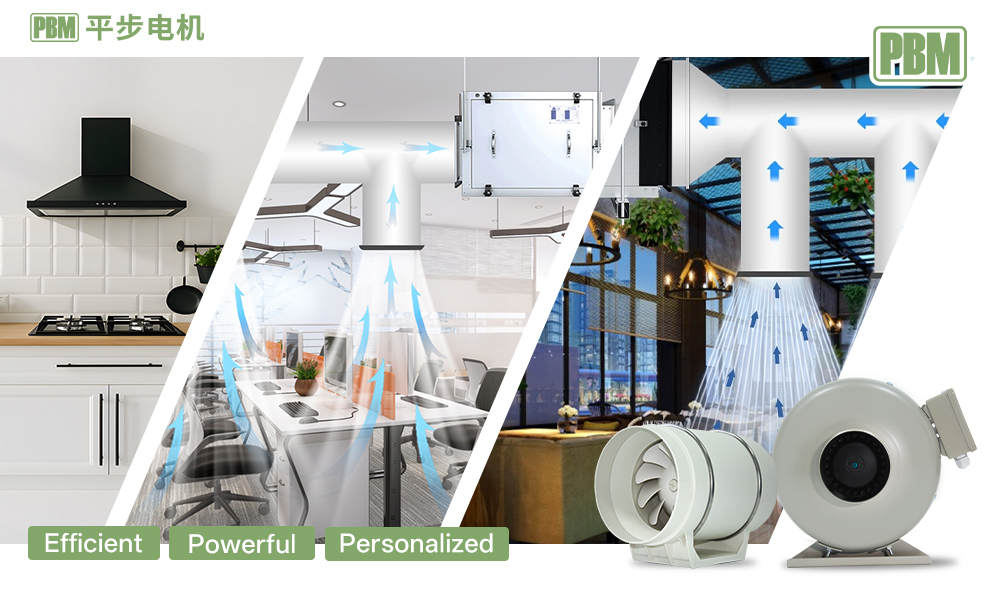
At PBM, we carry a full line of inline duct fans, duct booster fans, quiet inline fans, and EC motor inline duct fans. Use our [inline duct fan CFM calculator] to find your perfect match, or contact our engineers for a free consultation.
 If you have any interest in our products,please feel free to contact us & we are ready to serve you

By continuing to use the site you agree to our privacy policy Terms and Conditions.