FOCUS ON EC FAN ONLY
FOCUS ON EC FAN ONLY
Centrifugal fans are the main power components in HVAC, industrial dust collecting, air purification, and large-scale ventilation systems. Among these, forward-curved and Backward Curved Centrifugal Fans exhibit distinctly different performance curves, efficiency characteristics, and service life due to their differing impeller designs. PBM, a reputable worldwide partner for ventilation solutions, has devoted years to fan design and production, providing two primary types of superior centrifugal fans. To assist you in making the best choice as soon as possible, this article will walk you through the concepts, benefits, applications, and performance comparisons.
1.1 Forward Curved Centrifugal Fans
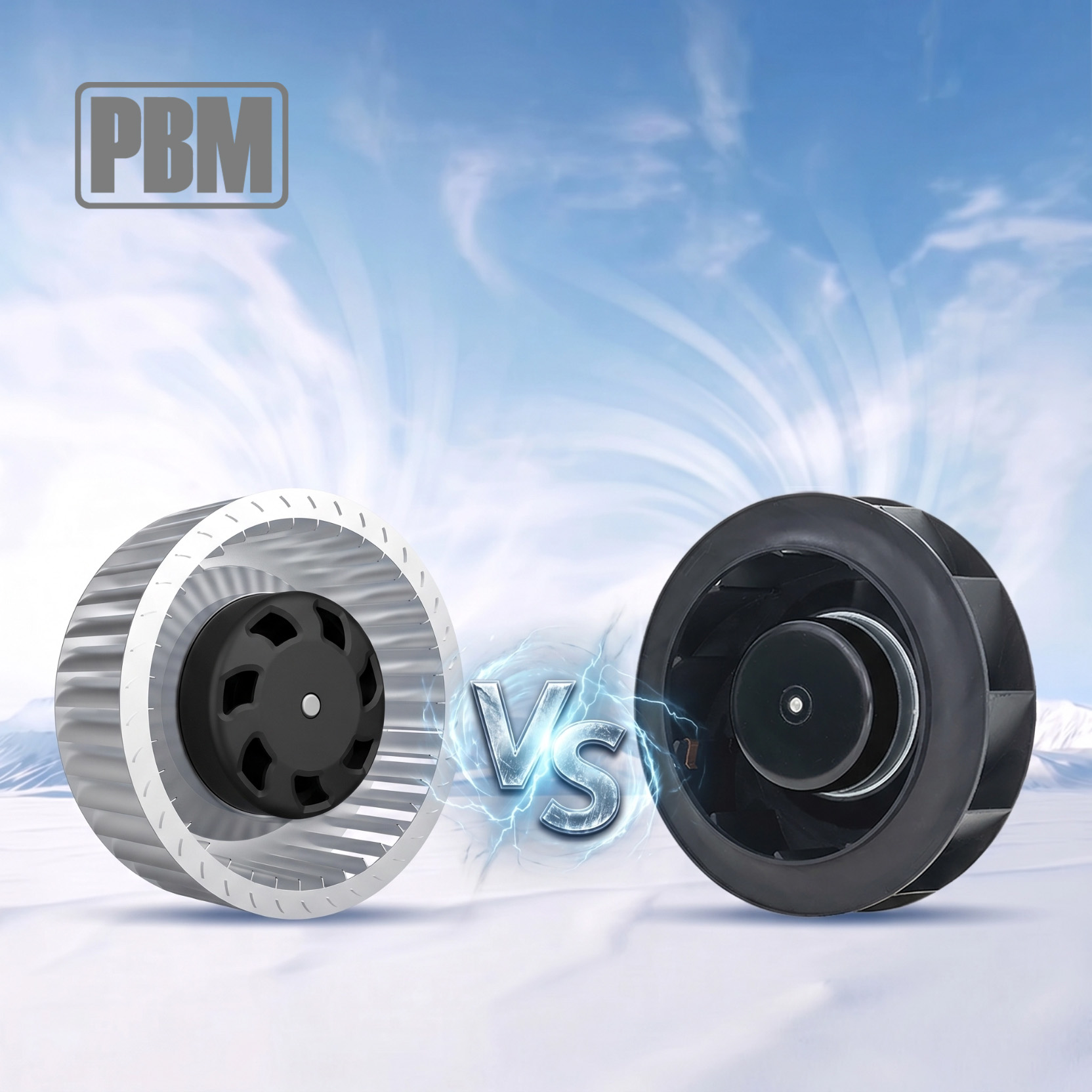
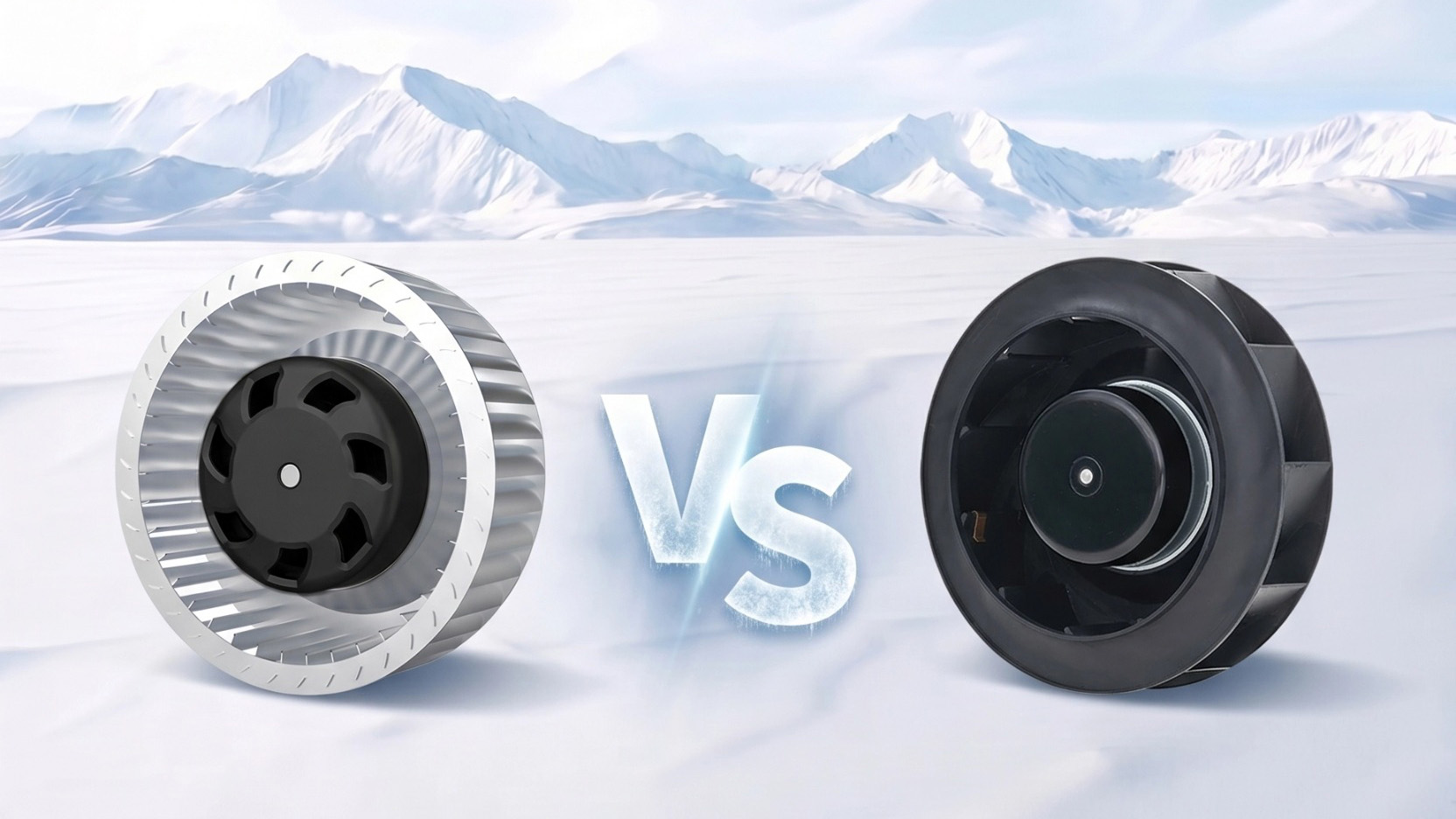
Blade orientation: The blades are especially well suited for applications demanding high airflow because they are bent in the direction of the impeller's revolution, as if "following the rotation."
Airflow Path: A high-pressure, high-power airflow is produced when air enters via the impeller's core, where it is accelerated and thrown outward by the revolving blades. It then travels through the volute, where its speed is decreased and its pressure is raised.
Dynamic pressure is subsequently transformed into static pressure when the air slows down and diffuses inside the volute.
Typical features include a short breadth, a comparatively small impeller diameter, and 32–64 blades. Forward-curved blades provide more pressure for a given diameter, although they are sensitive to cleanliness and air density.
1.2 Backward Curved Centrifugal Fans
Blade Direction: A backward-curved design is one in which the blades' curvature is against the impeller's rotational direction, giving the impression that they "rotate in reverse." Flat backward-curved and airfoil backward-curved blades are common varieties. Its capacity to produce extremely high static pressure is a benefit.
Airflow Path: Low flow losses and increased energy conversion efficiency occur from the airflow's smooth, non-violent passage over the rear of the blades.
Typical Features: These fans, which usually have 12 to 24 blades and a high impeller diameter, have a non-overload power characteristic, which lowers the danger of motor burnout from valve closure by stabilizing or even slightly decreasing shaft power as airflow increases.
1.Main Benefits
①Small Size, Space-Saving Design
Forward-flow fans may employ smaller impellers and housings because they produce higher total pressure at the same airflow and rpm. PBM's forward-flow fans are around 25% to 35% smaller than backward-flow counterparts with the same airflow, which makes them perfect for incorporation into tiny devices like air purifiers and indoor air conditioners.
② Minimal initial outlay
High-volume production can benefit from the straightforward manufacturing method, which uses little material and has low tooling costs. By providing standardized forward-curved fan modules, PBM successfully assists OEM clients in managing BOM expenses.
③ Reaching High to Medium Pressure at Low RPM
For instance, a forward-flow fan only has to spin at 1,200 RPM to reach an air pressure of 500 Pa, whereas a backward-flow fan needs to run at 1,800 RPM.The life of the motor bearings and the total noise levels of the device are indirectly affected by this.
2.Common Uses of Forward-Flow Fans (PBM Success Stories)
Indoor split-system air conditioners, window units, and ducted units are available for both residential and commercial use.
Heat recovery ventilators, dehumidifiers, and air purifiers are examples of small HVAC equipment.
Woodworking dust extraction and small-scale powder transportation are examples of low-pressure industrial dust extraction.
Low-resistance ducting is used in kitchen exhaust systems to remove cooking fumes.
1.Key Benefits
①high efficiency of total pressure.
Airfoil-blade backward-curved versions can attain 88%–92% efficiency, whereas flat-blade backward-curved models can reach 75%–85%. Long-term power cost reductions of 15% to 30% are possible with PBM's AMCA-certified HIB-AC line of airfoil-blade backward-curved fans, which have a maximum efficiency of 91.5%.
② Better Noise Reduction
These fans do not make loud whistling noises because they have reduced airflow separation losses and a frequency spectrum with fewer high-frequency components. Because PBM backward-flow fans have an incorporated sound-attenuating volute, their overall sound pressure level is 5–8 dB(A) lower than that of forward-flow fans.
③ No Overload Features
The risk of motor burnout is eliminated since the motor power will not above the rated value even if the outlet valve is fully open or a duct separates. They are therefore especially well suited for variable air volume (VAV) systems.
④ Superior Reliability and Speed
It is appropriate for high-temperature flue gas (PBM provides nickel alloy backward-curved impellers with a temperature resistance of 400°C) or high-pressure working circumstances since the impeller's linear velocity may reach over 100 m/s.
⑤ Robust Self-Cleaning Ability
Dust cannot stick to the backward-curved blades' surface because to the high gas velocity; even if it does, centrifugal force will immediately remove it. As a result, applications involving dust-laden gases (such as cement, foundry, and woodworking dust collecting) make extensive use of these impellers.
2. Common Use Cases (PBM Success Stories)
Subway/tunnel fans, AHU units, and modular air handling units are examples of central air conditioning and large-space ventilation.
Baghouse dust collectors, cyclone separators, desulfurization, and denitrification systems are examples of industrial dust collection and exhaust gas treatment.
Boiler driven and induced draft, drying equipment, and kiln-induced draft are examples of high-temperature flue gas exhaust.
Pharmaceutical production facilities and cleanrooms are high-standard settings that need little operating noise and excellent efficiency.
PBM has an extensive R&D, production, and testing infrastructure for both the highly efficient and dependable backward-curved centrifugal fans and the small and affordable forward-curved centrifugal fans. For HVAC, commercial refrigeration, industrial ventilation, and environmental dust removal applications, we regularly supply premium centrifugal fans all over the world. We also fully support custom voltage options (110V/220V/380V/400V/690V) and special material designs to satisfy a variety of engineering requirements.
Please visit the PBM website and fill out a technical requirements form if you need to adapt an existing system or are searching for fans for a new product. Within a day, we will match you with the best model.
 If you have any interest in our products,please feel free to contact us & we are ready to serve you

By continuing to use the site you agree to our privacy policy Terms and Conditions.