FOCUS ON EC FAN ONLY
FOCUS ON EC FAN ONLY
PBM: Giving clients all over the world a thorough, expert overview of centrifugal fan types in order to provide accurate and effective airflow solutions. Centrifugal fans are the "central respiratory system" for many industries, such as electronic cooling, HVAC purification, and contemporary industrial ventilation. They are available in many different forms and have a wide range of uses. The performance qualities and range of applications of a fan are determined by various classification criteria. PBM provides a wide range of products, such as forward-curved centrifugal fans, backward-curved centrifugal fans, frame-mounted fans, volute fans, and axial fans, by utilizing the technical know-how it has amassed over many years in the fields of EC energy-saving motors and fans. This allows PBM to provide global equipment manufacturers with thorough and accurate selection solutions.
Centrifugal fans can be categorized in a number of ways, but the most traditional and technically unique approach is based on the blade exit angle. Based on their departure angle, centrifugal fan blades can be classified as either forward-curved, radial, or backward-curved. A forward-curved fan occurs when the blade outlet angle β is larger than 90°, meaning that the blade curvature and impeller rotation are in the same direction. A backward-curved fan occurs when β is less than 90°, so that the blade's curvature is in the opposite direction of the impeller's spin. It is referred to as a radial fan when β = 90°.
In terms of performance features, forward-curved impellers produce the maximum pressure; they have a compact design and need the shortest impeller diameter under fixed flow rate and rotational speed circumstances, but their efficiency is often lower. Although they need the biggest impeller diameter and provide the lowest pressure, backward-curved impellers are often more efficient. Between the two are radial impellers. Under similar conditions of rotational speed, flow rate, and total head, forward-curved blades create a higher total head, but the fraction of dynamic head within the total head is bigger, resulting in more energy loss throughout the flow path and therefore worse efficiency. Backward-curved blades, on the other hand, produce a lower total head but a larger percentage of static head, which results in a much better efficiency and less energy loss throughout the flow path. A clear technological foundation for choosing fans for various application contexts is provided by this performance differential.
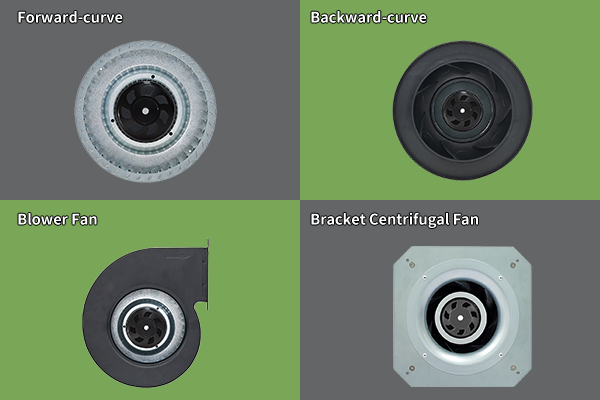
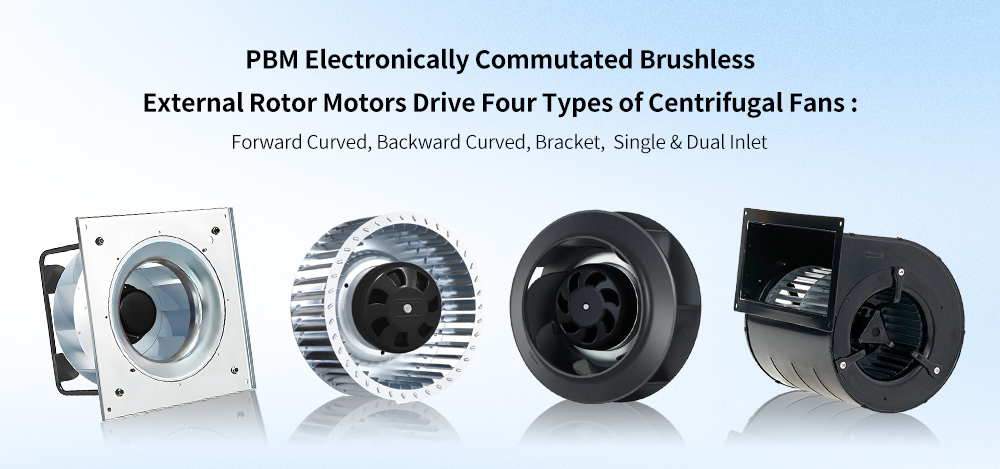
The blade tips of forward curved centrifugal fans bend in the direction of the impeller's rotation, thus the name. These fans are especially useful for systems with high air resistance but limited installation area or speed requirements because of their short, closely spaced blades, which produce strong static pressure at comparatively low speeds. Forward-curved centrifugal fans are a great option for low-pressure, high-airflow applications because of their small size, minimal operating noise, and compact construction.
Fan coil units, air handling units in commercial buildings, household central air conditioning systems, and small-scale drying equipment are examples of typical uses. They are also frequently utilized in cleanroom ventilation systems that need medium to high pressure in order to provide steady air circulation and guarantee compliance with air quality regulations. It should be mentioned, nevertheless, that forward-curved centrifugal fans have a comparatively lower peak efficiency than backward-curved types, and that noise levels may rise when operating at high speeds or outside of design parameters.
Backward curved centrifugal fans, the most popular kind, with blades whose tips are bent in the opposite direction of the impeller's spin. There are comparatively fewer and longer blades on these fans. They are the equipment of choice for industrial applications demanding high pressure and high airflow because of their fundamental benefits, which include great efficiency, energy savings, and dependable high-pressure output. Compared to forward-curved fans, this kind of fan produces a far better peak efficiency, uses less energy while in use, and provides more performance stability when running outside the design parameters. Additionally, it has excellent noise management, which makes it perfect for industrial applications that need to run continuously for extended periods of time.
Backward curved centrifugal fans are typically used in large-scale engineering projects and heavy industry, such as boiler ventilation in thermal power plants, flue gas exhaust from smelting furnaces in the metallurgical industry, gas transportation in chemical plants, ventilation and air exchange in large industrial facilities, and aeration systems in wastewater treatment plants. Additionally, backward curved fans are crucial to the reliability of centralized ventilation systems for large commercial complexes and smoke exhaust systems for high-rise buildings due to their exceptional efficiency and dependability. It should be noted that centrifugal fan backward curved requires a unique installation location due to their relatively large size, and their initial equipment investment costs are slightly more than those of forward-flow counterparts.
PBM's IP44 EC series product catalog focuses on two primary product lines: forward-curved and backward-curved centrifugal fans. Forward curved fans provide "high static pressure, low noise, and little energy loss," whereas backward curved fans are characterized by "higher airflow performance and lower power consumption." Additionally, both forward-curved and backward-curved product lines are part of PBM's IP55-rated EC series. The forward centrifugal fan catalog highlights the special features of "high static pressure, low noise, and low energy loss," while the backward centrifugal fan catalog still highlights "superior airflow performance and reduced power consumption."PBM's dual-product-line approach fully demonstrates its comprehensive coverage of diverse technical methodologies and application demands.
In addition to products meant for conventional installation, Centrifugal fans with bracket have emerged within the centrifugal fan category to address certain spatial conditions and installation requirements. By adding particular mounting brackets or frames to standard centrifugal fans, bracket-mounted fans essentially adjust to more flexible and demanding installation circumstances. Bracket-mounted fans are a crucial component of PBM's whole line of ventilation products, together with centrifugal, cross flow fan, Centrifugal fans with bracket, and axial fans. PBM has shown bracket-mounted fans in major international exhibitions, including the 2024 Moscow World Climate Expo and the International Refrigeration & Air Conditioning Expo in the United States.
How to manage installation challenges in certain circumstances is the technological foundation of bracket-mounted fans. To ensure stability and dependability while in operation, vehicle-mounted centrifugal fans in automotive applications require specific mounting methods. Relevant technological solutions recommend a design approach that uses anti-disengagement components together with fan mounting plates, stop plates, and different pressure plates to secure and limit the fan's movement. This guarantees that even in very vibrating circumstances, the fan will function correctly. In automobile heating systems, a fan mounting bracket is required to attach the mounting framework of backward-curved centrifugal fans to the air duct. The fan's air guide ring is concurrently altered to extend into the fan's intake in order to regulate airflow and prevent turbulence. This mounting structure is easy to install and fits snugly.
Centrifugal fans with bracket are also frequently utilized in industrial settings and large-scale equipment installation scenarios. These fans employ suspension brackets to facilitate mounting and installation. Their primary parts are a housing, motor, impeller, motor mount, and suspension brackets. The motor is connected to the impeller and secured within the housing by the motor mount, while the suspension brackets are mounted on the exterior of the housing. The synchronized action of the mounting points, suspension connections, and bracket body allows the fan to be suspended or wall-mounted. Using its extensive OEM expertise and modification skills, PBM may provide tailored mounting bracket solutions depending on specific customer installation requirements. This guarantees that the fan operates at its best in any particular spatial circumstances.
Among centrifugal fans, volute fans are among the most common and important design kinds. One of the most popular types of centrifugal fans in everyday industrial applications is the volute fan, which is just a centrifugal fan with a snail-shell-like spiral casing. Volute fans are not a separate category from centrifugal fans, but rather a specific product type developed by improving installation structures or housing designs based on centrifugal fans, much like frame-mounted fans. The volute has a rapidly rotating impeller. The impeller is powered by an electric motor, and centrifugal force drives the gas toward the inner wall of the volute. The unique, gradually increasing flow pattern of the volute efficiently converts the kinetic energy of the gas into pressure energy, resulting in a constant, high-pressure airflow.The volute's ability to collect gas, convert pressure, and reduce turbulence losses is what makes this structural design so valuable. Compared to fans with the same impeller diameter and rotational speed, this allows the centrifugal fan to attain smoother airflow characteristics and improved static pressure efficiency.
Single-inlet and double-inlet blowers are two other categories of volute fans. In contrast to double inlet blowers, which prioritize "quiet operation and a robust, vibration-resistant volute," single inlet blowers have "higher static pressure and a robust, vibration-resistant volute" as their primary technical features, making them appropriate for applications like industrial ventilation, purification equipment, and dust collection systems that require overcoming significant system resistance. They may intake a greater airflow volume at the same rotating speed while offering a more equal airflow distribution and reduced noise levels since the impeller draws air from both sides at the same time. They are extensively utilized in commercial ventilation systems, air handling units, and central air conditioning terminals. The centrifugal impeller is the fundamental component of both single-inlet and double-inlet systems. The drive motor can be either an AC motor or PBM's own EC brushless motor, and the blades can be either forward-curved or backward-curved. As a result, the volute fan is basically a centrifugal fan that has been improved and encased. Similar to the frame fan, it is a useful branch of the centrifugal fan family that was developed to satisfy certain installation needs or performance goals.
PBM has provided volute fans with cutting-edge features including high efficiency, energy savings, intelligent speed control, and remote monitoring by utilizing its exclusive EC brushless motor technology. The company's volute fan products may be tailored to meet client specifications for mounting brackets, inlet/outlet dimensions, communication protocols (RS485, Modbus, etc.), and protection ratings (up to IP55). High-end household appliances, medical purification equipment, data center cooling, cleanroom FFUs, HVAC, and thermal management for novel energy storage all make extensive use of them.
The segmentation of centrifugal fan categories and careful product selection are becoming the main points of industry competition as demand in downstream application sectors—such as industrial ventilation, HVAC, data center cooling, new energy storage, and medical air purification—continues to diversify and evolve. PBM is offering global equipment manufacturers end-to-end airflow solutions, from selection consulting to custom development, by utilizing its balanced portfolio of forward and backward curved fans technologies, flexible innovation in specialized categories like bracket fans, and a diversified product matrix covering volute fans, axial fans, and cross-flow fans. PBM's competitiveness in both local and foreign markets is further enhanced by the company's extensive certifications throughout its five main product lines, quick delivery capabilities (samples are ready in three days, while bulk orders take three to four weeks), and a five-year warranty promise for EC fans. To achieve optimal system energy efficiency and long-term dependable operation, engineering designers and equipment buyers must have a thorough understanding of the performance characteristics and appropriate applications of various centrifugal fan types in addition to PBM's wide range of product models and technical specifications.
Concerning PBM (Suzhou Pingyun Electromechanical Technology Co., Ltd.)
PBM is a mainland Chinese business that provides high-performance, energy-efficient EC brushless motors and fans to equipment makers across the world. Research, development, design, sales, and import/export of EC energy-saving motors, fans, and associated components are the company's areas of expertise. PBM is committed to making sure its products better meet and beyond the demands and expectations of its customers by continuously striving for excellence. Brushless EC motors, centrifugal fans, bracket fans, volute fans, axial fans, and cross-flow fans are among the company's product offerings. These fans find extensive application in ventilation and purification, HVAC, refrigeration and cold chain, information technology and electronics, medical equipment, heating systems, thermal management for new energy vehicles, home appliances, and data centers.
Please visit the official PBM website at https://www.pbmmf.com/ for further product details and technical questions.
 If you have any interest in our products,please feel free to contact us & we are ready to serve you

By continuing to use the site you agree to our privacy policy Terms and Conditions.